BS Banking Annual 2019: Credit demand is firming up, says SBI chief

There may not be a sharp rise in demand for credit anytime soon, even as some pockets show signs of promise. Can this be sustained?
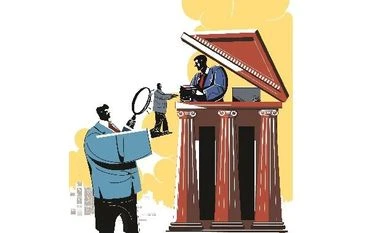
illustration
Illustration: Ajay Mohanty
Sachin P MampattaRaghu Mohan
9 min read Last Updated : Dec 18 2019 | 9:52 PM IST
Rajnikant Ranka, a cement dealer in south-central Mumbai, hopes that with a new state government in place, demand will pick up. “Let us see what they do,” he says, speaking on the day Uddhav Thackeray was sworn in as chief minister. He hopes the new dispensation’s policies will help build on the latest Reserve Bank of India (RBI) data for the cement sector, which shows an 18.2 per cent year-on-year (YoY) rise in credit growth in October 2019 — among the largest increases for major industries.

Rajnish Kumar, chairman of the State Bank of India (SBI), is candid that “the demand slowdown is a reality,” even as he appears upbeat: “The fact is also that in October and November, everybody said that we were better off than we were in August.” Kumar adds that, based on the bank’s conversations with businessmen, industrialists and manufacturers, it seems that the economy is on the recovery path, and things are looking up.

The undertone in what Kumar says is unmistakable: “Don’t expect an uptick on the double”. It resonates in the observation of Aditya Puri, managing director of HDFC Bank, that “the September numbers may not be that good, but is there scope for optimism? I think, yes. But please do not have unbounded optimism, though there will be a recovery.” He adds: “Our own estimate is that from the first quarter of the calendar, we will see a gradual pick-up.” 

Romesh Sobti, managing director and chief executive officer at IndusInd Bank, feels that “you can see a turnaround in some of the cyclical industries,” but hints that it could take some time before a secular lift-off in credit is seen. The point he makes is that while individual banks may see an increase in credit off-take — to the extent, say, that non-bank financial companies (NBFCs) are yet to regain the form displayed in the past — “it will not be correct to expect that the market for credit itself will expand.”

The fog continues

But how do you square this level of optimism — nuanced and qualified as it is — with the GDP print for Q2 FY20, which came in at 4.5 per cent (the slowest expansion in 26 quarters after the 4.3 per cent showing in Q4 FY13), down from five per cent in Q1 FY20?

Sonal Varma, chief economist-India and Asia ex-Japan at Nomura, is blunt: “Unfortunately, the forward-looking data do not suggest much room for optimism. October activity data released so far remain weak.”

Despite the expected festive boost in October, vehicle sales growth was largely lacklustre, particularly among commercial vehicles and two-wheelers. The credit slump is still underway, with bank non-food credit growth slowing further to 7.9 per cent YoY in the first week of November, from 8.9 per cent in October. 

While total credit disbursed by both banks and shadow banks (or NBFCs) has slowed, Varma observes, “the differentiation between haves and have-nots among the shadow banks continues — one year after the crisis first erupted.” In turn, this has hindered the transmission process at a time when bank balance sheets remain stressed. “Hence, while base effects will turn positive going forward, we believe that fundamental growth supporters are still missing,” she adds.

One reason why some bankers appear upbeat is that state-run banks that were earlier under the central bank’s prompt corrective action (PCA) are now lending (though not at the levels of the past). This, coupled with the fact that many banks have stepped into the space vacated by NBFCs, may have created a false impression that banks are lending more to industry.

What must also be borne in mind is that there is no publicly available disaggregated data on the loans sanctioned by banks to industry vis-à-vis their disbursements; it could well be that only loan sanctions have picked up. There are other reasons tobe guarded, too.

Is this a mirage?

Despite the cement sector guzzling higher credit on a YoY basis, Ranka notes: “Nobody seemed to want to do business in November.” He is surprised at how severe the dip is, even for a relatively muted period after the festive season, when sales at his outlet, Ranka Traders and Lime Depot, can rise by 50-60 per cent.

Or take the sugar sector, which has seen a six per cent increase in YoY credit growth as of October, higher than the 3.4 per cent rise in credit to industry as a whole. 

Prabal Banerjee, group finance director for the Shishir Bajaj group of companies, which includes industry major Bajaj Hindusthan Sugar, says that while there has been some improvement in the fortunes of the industry, it is not due to higher demand for sugar. “The sugarcane crop in Maharashtra was affected by rains, and sugar prices moved up, which has helped the industry,” he adds. What is left unsaid here is that had there been a good crop, price realisation would have been lower. 

So, should we buy into the narrative that the fall in the GDP print for Q2 FY20, at 4.5 per cent, may be the worst it can get? It depends on whom you ask, and nobody is any wiser than the next person.

What’s in the granular?

A closer look at the central bank’s data on sectoral deployment of credit shows that it is retail which is shoring up the numbers, not wholesale loans.

The wholesale-retail loan split in the first half of FY20 for SBI stood at 53.9:46.1, compared to 57.3:42.7 in FY19; it is a big change from 59.6:40.4 in FY17. Likewise, swings were seen for Punjab National Bank, ICICI Bank and Axis Bank as well. There was a trend reversal at HDFC Bank, because it is now picking up corporate loans. 

That said, “Credit demand is firming up and is coming from roads, solar power projects, and from the oil and gas sector, in particular, from the city-gas projects for SBI,” says Kumar. For HDFC Bank, the festive season has seen “phenomenal returns”, says Puri, who adds that demand is coming from the retail segment, particularly in the case of two-wheelers, and is being generated from rural and semi-urban areas. Payment-system-related demand from merchants has been strong for the bank, as has the working capital requirement of smaller companies. But Puri adds for good measure: “So, slowly things are coming up, but remember, when an elephant sits down, it takes a little bit of time to make it stand again.”

Credit is down 4.6 per cent for textiles, and 15.3 per cent for the glass and glassware segment. Basic metal and metal products have seen a decline of 7.1 per cent. Some of the sectors other than cement and sugar that have seen an increase in lending include fertilisers (35.3 per cent) and telecommunications (33.8 per cent) on a YoY basis. 

But these pockets of resilience in a slowing economy may well be tested in the days ahead, and this will reveal how durable the mood is. Then again, while YoY credit growth may be high for some sectors, not all of them are optimistic about the plot ahead.

For instance, it is unlikely that telcos will emerge from the woods anytime soon, despite the rescue package announced for them; it will not be out of place to think that there will be a tepid response to the 5G spectrum auctions next year. Of course, the hike in service charges in the prepaid segment in December will see many of them breathe easy.

H M Bangur, managing director at Shree Cement, expects “a pick-up in cement demand” over the medium-term, and expects to bet thousands of crores over the next three years on an uptick. “We will set up additional capacity of 15 million tonnes, which means about Rs 8,000 crore in investment.”

What now?

One reason for Bangur’s optimism could be the fact that the Centre may well loosen its purse strings in the upcoming Budget, and not adhere to the fiscal deficit target of 3.3 per cent of GDP. If this happens, it can be expected to provide a boost to infrastructure and enable the economy to cash in on the resulting multiplier effect on demand.

Madan Sabnavis, chief economist at Care Ratings, notes that the government has been spending on infrastructure such as roads and railways. “This has had a positive effect on segments like steel and cement. Wherever the government is involved, we have seen that there has been traction”. The last quarter of the current fiscal year may also see a boost in growth, since many states follow a policy of waiting until the last quarter to spend money.

Seshagiri Rao, joint managing director and group chief financial officer at JSW Steel, sees some improvement relative to September. “September was the worst month, whereas in October and November, there was definitely an improvement in overall demand.” The pick-up seems government-driven.

“This year, prior to the elections, we saw a significant slowdown in the release of monies and in the government award of projects, which restarted in September. So, the only point of discussion is whether there is adequate fiscal space to continue the pace of spending,” he adds. He thinks that private sector investment may be at least be two or three quarters away.

Banerjee believes that the recent uptick in the sugar sector will have to be closely watched. “There is already excess supply of sugar in the system. It didn’t become a problem only because Maharashtra had very low production figures this year. But otherwise, sugar has been in excess production and nobody will add capacity.”

Domestic sugar production in the crushing season was down by around 65 per cent to 485,000 tonnes, according to data as of November 15. The Indian Sugar Mills Association put sugar production at 1.34 million tonnes in the same period last year.

Green shoots of recovery? Not quite. 

One subscription. Two world-class reads.

Already subscribed? Log in

Subscribe to read the full story →
*Subscribe to Business Standard digital and get complimentary access to The New York Times

Smart Quarterly

₹900

3 Months

₹300/Month

SAVE 25%

Smart Essential

₹2,700

1 Year

₹225/Month

SAVE 46%
*Complimentary New York Times access for the 2nd year will be given after 12 months

Super Saver

₹3,900

2 Years

₹162/Month

Subscribe

Renews automatically, cancel anytime

Here’s what’s included in our digital subscription plans

Exclusive premium stories online

  • Over 30 premium stories daily, handpicked by our editors

Complimentary Access to The New York Times

  • News, Games, Cooking, Audio, Wirecutter & The Athletic

Business Standard Epaper

  • Digital replica of our daily newspaper — with options to read, save, and share

Curated Newsletters

  • Insights on markets, finance, politics, tech, and more delivered to your inbox

Market Analysis & Investment Insights

  • In-depth market analysis & insights with access to The Smart Investor

Archives

  • Repository of articles and publications dating back to 1997

Ad-free Reading

  • Uninterrupted reading experience with no advertisements

Seamless Access Across All Devices

  • Access Business Standard across devices — mobile, tablet, or PC, via web or app

Topics :BS Banking Annual

Next Story



