Govt assures PSBs capital this fiscal
Earlier govt had allocated in budget Rs 11,200 cr for capitalisation in public sector banks
Nupur Anand Mumbai The government has assured public-sector banks (PSBs) that it will infuse capital before the end of the current financial year. This was communicated to the banks by the finance ministry during Gyan Sangam, a two-day retreat in Pune on Saturday.
During the interim Budget presented by the United Progressive Alliance government in February last year, Rs 11,200 crore was allocated for capitalisation in PSBs. Typically, the first tranche is allocated to the banks within the first half of a financial year. However, the PSBs haven’t received any capital from the government so far.
They have been under stress owing to higher provisioning due to rising non-performing assets.
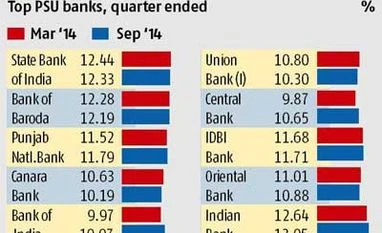
“We have received assurance from the government that the promised capital will be given in this financial year,” said the chief executive of a PSB on the sidelines of the retreat. According to data from the Reserve Bank of India (RBI), between March and September 2014, the total capital and risk weighted assets of scheduled commercial banks increased by 1.9 per cent and 4.1 per cent, respectively.
This has resulted in a decline in the capital adequacy ratio from 13 per cent to 12.8 per cent. RBI’s financial stability report has also noted out that capital infusion efforts by PSBs, other than the capital infusion by the government, will be challenging because of their relatively low equity valuations, compared to private-sector peers. The National Democratic Alliance government, which is cutting expenditure to meet its fiscal-deficit target, has favoured raising funds from the market by the PSBs. Even though the stock markets were upbeat in 2014, which enabled many private banks to raise capital via qualified institutional placement, PSBs were unable to do so due to poor valuations.
The government needs to infuse Rs 2.4 lakh-crore equity in PSBs by 2018 to meet Basel-III requirements on capital adequacy, in order to hold on to its present stake.
In FY14, the government had infused Rs 14,000 crore in PSBs.
In December 2014, the government had said it had allowed PSBs to raise up to Rs 1.60 lakh crore from the markets by diluting government holding to 52 per cent in phases so as to meet Basel III capital adequacy norms. However, Jayant Sinha, minister of state for finance, stated that these dilutions would happen only at “appropriate valuations”.
“The government is fully committed to supporting and providing all of our financial institutions with the capital needed to provide the liquidity and credit to revive the economy. It is our responsibility to ensure that if we're going to dilute our stake, which is the stake of the people of India, we'll do it at an appropriate valuation,” he added on the sidelines of Gyan Sangam.

 "Govt assures PSBs capital this fiscal")


 Connect with us on WhatsApp