Liquidity deficit again crosses Rs 100,000 cr
Lack of govt spending seen as problem
Neelasri Barman Mumbai
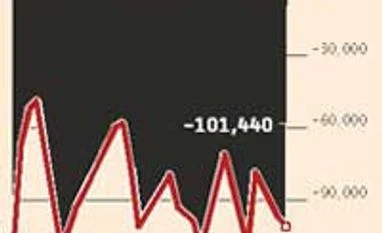
Lack of government spending continues to hit liquidity in the banking system, with banks borrowing more than Rs 1 lakh crore daily from the Liquidity Adjustment Facility (LAF) of the central bank.
According to bankers, more bond purchases by open market operations are expected from the Reserve Bank of India (RBI). However, the problem is seen as a temporary rather than a structural issue.
Yesterday, RBI governor D Subbarao had said the central bank was open to using the Cash Reserve Ratio tool for easing liquidity.
In last week’s annual review of monetary policy, RBI kept the CRR (the proportion of cash reserve each bank must keep with it) unchanged at four per cent, while reducing the repo rate (at which it lends to banks) by 25 basis points, to 7.25 per cent.
The liquidity deficit in the system is expected to remain around Rs 1 lakh crore (a day) till the government starts spending more.
This level of deficit is above RBI’s comfort level of plus/minus one per cent of net demand and time liabilities. Dealers said the central bank should conduct more purchases of government securities (a part of what are termed OMOs, or open market operations)
Banks borrowed Rs 101,440 crore on Tuesday under the LAF auction, compared with the liquidity deficit of Rs 97,615 crore yesterday. This is the seventh occasion in this financial year (starting April 1) when the deficit has crossed Rs 1 lakh crore.
“A liquidity deficit of Rs 1 lakh crore is now considered normal. RBI should ensure it does not touch Rs 1.5 lakh crore,” said a treasury official with a private bank. According to officials, there have been outflows on account of pending tax, beside the service tax outflow of Rs 15,000-20,000 crore.
RBI is auctioning government securities worth Rs 15,000 crore every week, which is also impacting liquidity, the official added. RBI had said it would conduct an OMO of up to Rs 10,000 crore on Tuesday; it bought government securities worth Rs 9,658 crore.
“The government cash balance with RBI is as high as Rs 90,000-100,000 crore. That should flow back to the system to comfort the liquidity deficit,” said a treasury official of a public sector bank. The Street expects more OMOs by RBI this month; else, the deficit is expected to climb to Rs 1.5 lakh crore.
“The deficit is frictional. If the government starts spending and banks start unwinding their excess (of) Statutory Liquidity Ratio (this is the proportion of total deposits they are required to maintain in the form of liquid assets), funded by deposits or absorbed by OMOs, the liquidity situation will improve,” said J Moses Harding, head of the asset/liability committee at IndusInd Bank.
Subbarao said in a post-monetary policy conference call to analysts and researchers yesterday that the auctioning of the government’s cash balances was being discussed. However, he noted, auctioning this would not change the overall liquidity situation.
“Banks, instead of borrowing from the LAF window, will be getting these securities through some other window. Overall, it will not change the liquidity situation; it will change the costs to the government. We will come to a decision when we conclude our discussions with the government,” he’d said.

 "Liquidity deficit again crosses Rs 100,000 cr")


 Connect with us on WhatsApp