Loan recast hits roadblock as promoters fail to contribute
Lack of consensus among banks leading to rejections
Manojit Saha Mumbai The inability of promoters to contribute has become a major hurdle to the debt restructuring mechanism. As a result, the loan recast proposals of banks are increasingly being rejected.
After companies and banks started taking undue advantage of the debt restructuring process, the Reserve Bank of India (RBI) made the norms concerned stringent by prescribing high contribution from promoters.
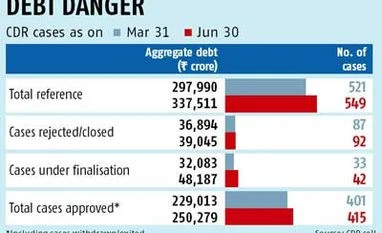
As on June 30, 549 cases had been referred to the corporate debt restructuring cell. Of these, 92, worth about Rs 40,000 crore, were closed or rejected, against 87 cases worth Rs 37,000 crore in March. The data for September are still been finalised; bankers expect the numbers to rise.
In case a company wants to restructure the loan payment schedule, 75 per cent of the creditors of the consortium (by value) should agree to the recast. Once it is agreed a particular loan would be restructured, the specific contours are decided. According to RBI guidelines, based on the recommendation of the Mahapatra committee, promoters must contribute at least 20 per cent of the loan amount a bank would forego in such a recast, or two per cent of the total restructured debt, whichever is higher.
“We are increasingly seeing even after an approval, the debt-restructuring proposals are not being implemented, as promoters are failing to bring in their share,” said a senior official of the corporate debt restructuring cell.
What has further complicated the process is the fact that most banks don’t agree to the terms and conditions. This has led to the rejection of many debt recast proposals. For instance, in the case of Winsome Diamonds & Jewellery (formerly Su-Raj Diamonds), which was referred to the corporate debt restructuring cell, banks didn’t agree on the package within the stipulated period. This resulted in the proposal being rejected. Various banks, including Punjab National Bank, Canara Bank, Union Bank of India and Central Bank of India, have exposure of Rs 4,000 crore in Winsome. Most banks have classified the loan as non-performing.
The reluctance of banks to admit companies in the debt restructuring cell also follows the finance ministry advising caution on the matter. The ministry wants banks to undertake such an exercise only if a borrower has genuine problems and it is felt the entity would repay the loans.
The ministry has also asked to be tough on wilful defaulters.

 "Loan recast hits roadblock as promoters fail to contribute")


 Connect with us on WhatsApp