The monetary policy announcement on February 7 will be one of the most critical ones in recent times for analysts because it will set the stage for the Reserve Bank of India’s (RBI’s) course of action.
The policy, coming a week after the Budget, could reverse the rate-cutting cycle for good and may hint at the central bank turning hawkish.
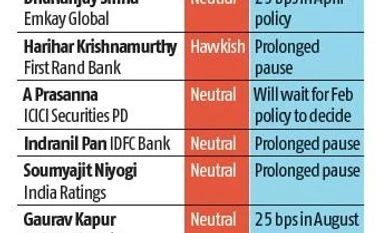
A poll by Business Standard of 12 economists and treasurers showed there was agreement that there will be a pause this time. But the debate was whether the policy stance would remain neutral, or how hawkish the tone of the policy would be, and, finally, if there would be a rate hike in the coming months.
There was a near-consensus that there would be at least one hike though they differed as to when it would happen.
The RBI last cut its policy rate in August — by 25 basis points, or bps (0.25 percentage point). Since then, the policy repo rate has been 6%. There is a consensus that the rate has hit its lowest level and in Calendar 2018, it should start hardening. The retail inflation rate in December hit 5.21%, a 17-month high.
The 10-year bond yield, at about 7.50% and rising, also poses a challenge for the central bank. The spread between the yield and the inflation rate, at 230 bps, is high and such high spreads usually happen during a crisis period such as the aftermath of taper-tantrum talks of 2013, said Soumyakanti Ghosh, chief economist of the State Bank of India group.
There is also no clear consensus if the Budget will be inflationary and how the inflation trajectory will work out. There is a debate about the inflation impact of the minimum support prices proposed in the Budget. Some also say from July the base effect will turn highly favourable for the central bank to not care about a hike.
“The combination of fiscal stimulus and rising commodity prices (mainly oil) will have a bearing on inflation. Besides, the liquidity situation can become a little tight, and when global yields are also rising, the RBI will be compelled to take a hawkish stance and start hiking rates sooner than expected,” said Dhananjay Sinha, chief economist, Emkay Global Financial Services.
Sinha expects a 25-bp rate hike in the April policy. And then there could be more for the remaining part of the year.
Madan Sabnavis, chief economist, CARE Ratings, said: “We are potentially staring at one more year of fiscal slippage. And with rising crude oil prices, it would be difficult for the RBI not to adopt a hawkish fiscal stance and pause for long.” Sabnavis expects rate hikes, but says it depends upon the oil price trajectory.
Gaurav Kapur, chief economist, IndusInd Bank, said: “The minimum support price cannot go unnoticed and will be seen with a lot of caution. Oil prices are going up but they may halt at a level after the winter is over. While growth is also expected to pick up, the output gap is closing. There should be a rate hike in 2018, maybe in the August policy.”
However, there are economists who differ. “There is not much upside to oil prices. US shell production is ramping up and February is usually the time when oil prices pick up due to the severe winter in the North. Starting in the second half, the base effect would be highly favourable for the consumer price index. If they hold now, there is no reason to expect rate hikes in the second half,” said Rupa Rege-Nitsure, group chief economist, L&T Finance.
According to Nitsure, the countercyclical fiscal policies by the government won’t be inflationary as capacity utilisation still remains low, while the exchange rate remains stable.
The monetary policy is important for other reasons too. “There should be better planning of liquidity and communication regarding that. There is certain imperfection in the market right now and the yields are not in sync with the market fundamentals. State governments are borrowing at rates higher than the marginal cost based lending rates of some banks, and this is a distortion,” said Ghosh.
Bond yields have risen at least 100 bps in the past three-four months. And it’s not because of the RBI’s actions. It shows that global central banks are calling the shots in the Indian market.
“The RBI has to establish its independence against rising external adversities,” said Soumyajit Niyogi, associate director, India Ratings and Research.