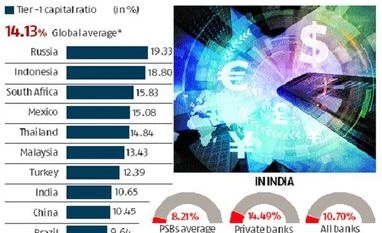
The public sector banks (PSBs) across the world have one of the lowest tier-I capital ratios. In FY18, the PSBs, on average, reported a tier-I capital ratio of 8.4 per cent, against the global average of 14.1 per cent. Analysts say this makes the PSBs vulnerable in case of an economic downturn.
In all, Indian listed banks reported a tier-1 capital ratio of 10.65 per cent in the last financial year — the lowest among the key emerging markets (EMs).
Only banks in China and Brazil had a lower ratio than their Indian counterparts, according to data from Bloomberg. Among major EMs, the banks in Russia are best capitalised with a ratio of 19.3 per cent, followed by those in Indonesia at 18.8 per cent.
Under the Basel-III norms, the banks in India have to maintain a minimum tier-1 capital ratio of 7 per cent. The banks are also mandated to have a capital conservation buffer of 2.5 per cent of their risk-weighted assets. In totality, the banks are required to maintain a minimum capital adequacy ratio of 11.5 percent by the end of March 2019, including 2 percent in tier-II capital.
According to Capitaline, four PSBs had inadequate tier-1 capital ratio (less than 7 per cent) at the end of March this year. Ratio of another 11 PSBs was less than 9.5 per cent, making them vulnerable in an economic downturn.
The private sector banks are in a much comfortable position, with an average tier-I capital ratio of 14.5 per cent. This was more tha the global average.
“Government-owned banks in India are among the weakest in the world. Vulnerability index for PSBs is high due to their low capitalisation,” said Dhananjay Sinha, head, research, Emkay Global Financial Services.
He says the PSBs don’t even have enough capital to make fresh lending forcing them to lose market share to private sector banks and non-banking finance companies. (NBFCs).
Experts say bank recapitalisation by the Centre has been inadequate, given the losses incurred by the banks. “Almost the entire amount of recapitalisation went towards funding banks’ provisioning for bad loans, and did not add much to improve their capital base,” added Karthik.
Analysts say the Centre may increase the recapitalisation budget if PSBs have to make fresh lending. Historically, the PSBs have financed bulk of the corporate projects as private sector banks and NBFCs largely operate in the retail lending space.
The newly listed Bandhan Bank tops the capitalisation chart with a ratio of 31.5 per cent at the end of FY18, followed by IDFC Bank (18.8 per cent) and Kotak Mahindra Bank at 17.83 per cent, respectively. Lakshmi Vilas Bank is at the bottom with a ratio of 8.75 per cent.
The analysis is based on the data on 39 listed banks in India, including 21 listed PSBs, excluding Jammu & Kashmir Bank.

 "PSBs are among least capitalised banks in the world, say experts")












