Trading in G-sec plunges as RBI tightens liquidity
Measures helped in stabilising rupee, resulted in yields rising high & traders in banks, insurance companies and fund houses losing appetite
Neelasri BarmanM Saraswathy Mumbai Trading volumes in government securities took a hit after the Reserve Bank of India’s liquidity tightening earlier this month to arrest a weakening rupee.
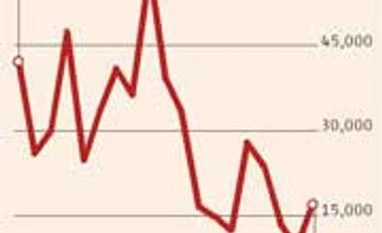
Though the measures helped stabilise the rupee, it resulted in rising yields and a loss of appetite for these securities among traders in banks, insurance companies and fund houses. Data from the Clearing Corporation of India shows the daily average trading volume till July 15 was Rs 37,388 crore. This dropped sharply to Rs 16,871 crore after RBI started tightening liquidity.
The yield on the 10-year benchmark government bond 7.16 per cent ended at 8.19 per cent on Thursday, compared with Wednesday’s close of 8.42 per cent.
The Street is concerned that RBI might do more to tighten liquidity in its first-quarter review of monetary policy on Tuesday, due to which trading interest has dropped considerably.
“The focus is now on rupee volatility and the central bank has been bringing out measures in quick succession, as they are concerned about the external factors on the rupee. After July 30, when the policy is announced, we will see some direction,” said Nirakar Pradhan, chief investment officer, Future Generali India Insurance.
Trading volumes dropped to Rs 9,218 crore on Wednesday after RBI further tightened liquidity by capping the daily Liquidity Adjustment Facility borrowing to half a per cent of each bank’s deposits. Besides, it said banks must keep a daily Cash Reserve Ratio balance of 99 per cent of the requirement.
“Trading volumes will be hovering around the current level. Only the most liquid securities will be actively traded. RBI might continue with these liquidity tightening measures for at least 30-40 days,” said N S Venkatesh, chief general manager and head of treasury, IDBI Bank, and chairman of the Fixed Income Money Market and Derivatives Association of India.
However, the RBI moves helped the rupee. It ended at 59.11 to a dollar on Thursday, compared with Wednesday’s close of 59.13. Since July 15, the rupee has strengthened by 79p.
Besides, as government bond yields started rising, it became attractive for foreign institutional investors (FIIs) to buy these at the current levels. Rising yields resulted in significant reduction in selloff by FIIs.
“If the rupee is stable at these levels, I believe this will give comfort to market players, which will then get reflected in the trading volumes of government bonds,” said Pradhan.
| RBI ACTIONS TO DEFEND THE RUPEE |
1998: Asian financial crisis
Measures during Jan 1998 - Rise in bank rate by 200 bps
- Increase in CRR by 50 bps
|
2000: Asian crisis aftermath/ tech bubble
Measures during July-August - Rise in bank rate by 100 bps
- Increase in CRR by 50 bps, 25 bps immediately reversed
|
2008: Global financial crisis
Measures during June-July - Rise in repo rate by 125 bps
- Increase in CRR by 75 bps
|
2011-12: Aftermath of the US debt downgrade
Measures during Sep-Dec - Increase in foreign currency non-resident (FCNR) account and non-resident external account (NRE) rates
- Increase in external commercial borrowing rates
- Other administrative steps
- 100 bps increase in repo rates during the depreciation period
|
| Present action |
July 8 - Banks were asked not to carry out any proprietary trading in the currency futures/ exchange traded currency options markets. In other words, any transaction by banks in these markets will have to be necessarily on behalf of their clients
|
July 15 - Increase in marginal standing facility (MSF) and bank rate to 10.25% (increase of 200 bps)
- Limit repo under LAF to Rs 75,000 crore. Above this funds are available at the MSF rate
- Open market sale of government securities of Rs 12,000 crore
|
July 22 - Liquidity adjustment facility (LAF) borrowing cap tightened to 0.5 per cent of each bank’s deposits
- Banks must keep daily cash reserve ratio (CRR) balance of 99 per cent (of requirement)
|

 "Trading in G-sec plunges as RBI tightens liquidity")


 Connect with us on WhatsApp