RBI policy: Rate pause season gets longer; Urjit Patel weighs risks

The repo rate was kept unchanged at 6.25%
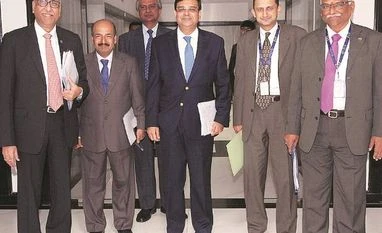
Urjit Patel, S S Mundra, N S Vishwanathan, M D Patra, Viral V Acharya and R Gandhi
Reserve Bank of India Governor Urjit Patel (centre), along with deputy governors (left to right) S S Mundra, N S Vishwanathan, Executive Director M D Patra, Viral V Acharya and R Gandhi in Mumbai on Wednesday PHOTO: KAMLESH PEDNEKAR
Anup Roy Mumbai
Last Updated : Feb 09 2017 | 9:04 AM IST
The six-member monetary policy committee (MPC) kept the Reserve Bank of India’s policy rates unchanged on Wednesday. And, shifted the policy stance to “neutral” from “accommodative”, as it wanted to keep the flexibility to move either side, hike or cut, considering the uncertain inflation landscape.

Bond markets were shocked by the pause and change in policy stance. Yields on the 10-year government security jumped 32 basis points (bps) to close at 6.75 per cent, the steepest climb in a day since September 29, 2013.

According to credit rating agency CRISIL, the shift could “very well mark the end of the current rate cut cycle, which began in January 2015 — at least in the near term.”

Business chamber Ficci said a cut would have given a push to demand, which has been hit by demonetisation.

Following RBI’s sixth bi-monthly monetary policy review and the last for the financial year, at which all the six members voted in favour of a pause, the repo rate remained unchanged at 6.25 per cent.

“The MPC was fully cognisant of the lags to which monetary policy typically operates. It was also sensitive to the need for a calibrated target, thereby minimising the collateral costs of achieving it. Therefore, it decided to shift the stance of monetary policy from accommodative to natural, to give sufficient flexibility to move in either direction,” RBI Governor Urjit Patel said in a post-revew press conference.

The change in stance essentially nixes the chance of any meaningful rate cuts by banks as well, lagging the cumulative 175-bps rate cut by the central bank since January 2015.

Patel said there was scope for further lending rate cut by banks. “Our policy rates came down by 175 basis points and the banks’ weighted average lending rate has come down by at most 85-90 bps,” he said, while noting that rates had fallen and some borrowers, such as home buyers, have benefited.

For timely transmission of the policy, the MPC set three goal posts — quick and efficient resolution of non-performing assets (NPAs), speedier recapitalisation of public sector banks and full implementation of the formula for determining interest rates on small savings, which would align these with government bond yields. While the first one comes under RBI’s ambit, the latter two goals fall in the ambit of the government.

Bankers did not offer any direct comment on the future course of lending rates.

“The RBI view is right, that monetary policy transmission will improve further if NPAs are resolved, the capital position of banks improves and small savings rates are more market-driven,” said State Bank of India Chairman Arundhati Bhattacharya.

Bank of Maharashtra Managing Director and Chief Executive Officer R P Marathe said, “Banks are already doing their bit, aided by easy liquidity in the system. The future course on MCLR (marginal cost of funds-based lending rate) will be purely governed by trends in underlying parameters like the marginal cost of funds, negative carry and cost of operations.”

Waiting to gauge the full impact of the demonetisation exercise, the central bank lowered its growth forecast for 2016-17 to 6.9 per cent from the 7.1 per cent it had forecast in its fifth bi-monthly policy in December. Before the demonetisation exercise, RBI was expecting the economy to grow at 7.6 per cent.

Nevertheless, the central bank still sees the impact of demonetisation as transitory and expects growth “to recover sharply in 2017-18”.

“The committee decided to change the stance from accommodative to neutral while keeping the policy rate on hold to assess how the transitory effects of demonetisation on inflation and the output gap play out,” the policy document said.

RBI’s monetary policy statement expressed concern on inflation firming up, on the back of rising energy prices.

Domestically, even as the consumer price index (CPI) gauge of inflation came much lower than RBI’s target of five per cent by March 2017, excluding food and fuel, “inflation has been unyielding at 4.9 per cent since September,” the document noted.

While some part of this could be attributed to the high crude oil prices since October, “a broad-based stickiness is discernible in inflation”.

While there is adequate supply of pulses to retain their prices, “vegetable prices may potentially rebound as the effects of demonetisation wear off,” the policy said, adding this persistence of inflation, “could set a floor on further downward movements in headline inflation and trigger second-order effects.”

The central bank’s CPI inflation is at 4-4.5 per cent in the first half of the financial year and in the range of 4.5-5 per cent in the second half. The fiscal prudence shown by the government in the Budget, keeping the fiscal deficit target contained at 3.2 per cent of the gross domestic product for 2017-18 “should bode well for limiting upside risks to inflation”.

In the policy press conference, RBI officials refused to give details of scrapped currency notes returned to banks, while Deputy Governor R Gandhi said as of January 27, the notes in circulation had been Rs 9.92 lakh crore, comprising all denomination, including ~500 and ~2,000.

Gandhi said the central bank would relax restrictions on withdrawal from savings bank accounts in two phases by March 13.

Key takeaways

Interest rates: RBI keeps interest rates unchanged; shifts policy stance to “neutral” from “accommodative”

Growth forecast: Lowered to 6.9% from 7.1%

Inflation: Concerns on global uncertainty in fuel and metals. Expects CPI inflation of 4-4.5% in the first half of FY18; 4.5-5% in the second half

Demonetisation impact: Transitory; growth to recover sharply in FY18. Remonetisation at Rs 9.92 lakh cr
as on January 27

One subscription. Two world-class reads.

Already subscribed? Log in

Subscribe to read the full story →
*Subscribe to Business Standard digital and get complimentary access to The New York Times

Smart Quarterly

₹900

3 Months

₹300/Month

SAVE 25%

Smart Essential

₹2,700

1 Year

₹225/Month

SAVE 46%
*Complimentary New York Times access for the 2nd year will be given after 12 months

Super Saver

₹3,900

2 Years

₹162/Month

Subscribe

Renews automatically, cancel anytime

Here’s what’s included in our digital subscription plans

Exclusive premium stories online

  • Over 30 premium stories daily, handpicked by our editors

Complimentary Access to The New York Times

  • News, Games, Cooking, Audio, Wirecutter & The Athletic

Business Standard Epaper

  • Digital replica of our daily newspaper — with options to read, save, and share

Curated Newsletters

  • Insights on markets, finance, politics, tech, and more delivered to your inbox

Market Analysis & Investment Insights

  • In-depth market analysis & insights with access to The Smart Investor

Archives

  • Repository of articles and publications dating back to 1997

Ad-free Reading

  • Uninterrupted reading experience with no advertisements

Seamless Access Across All Devices

  • Access Business Standard across devices — mobile, tablet, or PC, via web or app

Next Story



