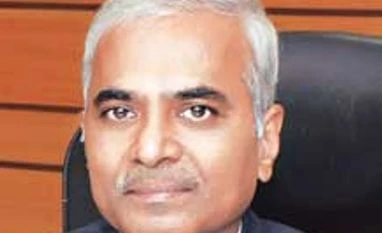
SBI is committed to providing excellent banking experience: Karnam Sekar
Interview with SBI Chief General Manager
Virendra Singh Rawat Banks, which act as custodians of funds and play a vital role in implementing monetary policies, are the backbone of an economy. India's largest lender, State Bank of India (SBI), has a major stake in the domestic banking sector. SBI Chief General Manager
Karnam Sekar tells Virendra Singh Rawat about the bank's plans and policies in Uttar Pradesh. Edited excerpts:
What is SBI's current branch network in Uttar Pradesh? What are the expansion plans? In UP, SBI has 2,061 branches - 1,550 under the Lucknow circle and 511 under the New Delhi circle. Almost 68 per cent of these are in rural and semi-urban areas. Depending on the potential and the banking requirements of the people, an average 130 branches are opened in the state every year. We also have 8,024 customer service points and 2,545 automated teller machines (ATMs) in Uttar Pradesh.
How is SBI progressing with the financial inclusion road map, especially with regard to the Pradhan Mantri Jan Dhan Yojana (PMJDY)? PMJDY is a national mission. Under it, SBI has covered 10,131 villages with population less than 2,000 each, by providing banking services. Besides, we opened accounts for unbanked households in 1,837 urban wards allocated to us by the State Level Bankers' Committee (SLBC).
Under PMJDY, SBI opened over 4.3 million accounts in UP and issued 3.9 million RuPay Cards to account holders. Now, our focus is on activation of the RuPay Cards and seeding of all these accounts with Aadhaar. These will enable the account holders to avail of all benefits available under PMJDY, such as accident insurance of Rs 1 lakh and life insurance of Rs 30,000, besides direct transfer of subsidies and other benefits in their accounts.
UP is a largely agricultural economy. How is SBI reaching out to this large agricultural segment? Our focus is on providing adequate financing to cultivation and animal husbandry. We are also focusing on investment credit in food processing and warehousing. We aim to provide integrated financing, such as funding for a dairy unit, milk-chilling centre and all farmers supplying milk to the dairy unit. That will help support the entire chain of activities. Our credit flow to the priority sector is much more than the stipulated 40 per cent.
Entrepreneurs with micro, small and medium enterprises (MSMEs) in UP complain that getting bank loan is quite difficult, especially in the absence of collateral. According to the bank's instructions, loans of up to Rs 50 lakh to all MSME borrowers are required to be compulsorily covered under the credit guarantee fund trust for micro and small enterprises (CGTMSE) scheme. Those above Rs 50 lakh to Rs 1 crore are covered under CGTMSE scheme in case the prospective borrower is willing to bear the premium. No collateral security is obtained for such loans and no viable proposal is turned down for want of collateral security. Focus is on the viability of the proposal.
The UP government has been quite bullish in upgrading infrastructure, such as road and energy. What would be contribution of commercial banks?
Proposals for funding of infrastructure projects (road and energy) are considered by the bank subject to their being economically viable. Specialised branches are set up for handling such project finance for the convenience of borrowers. Apart from funding the projects, all suppliers and sub-contractors are also provided need-based financing.
Inflation has started to ease lately and business confidence is showing signs of improvement. What will be the likely effect on bank advances, particularly in a state like UP?
With inflation easing and sentiment improving, interest rates have peaked; these might move southwards. All these will augur very well for industrial growth. Bank credit is going to see an upward push very soon.
The UP government often expresses concern over low credit-deposit ratio. What is your take on this?
Lower CDR certainly implies lower credit deployment. But this is closely linked to the level of industrial activity in the economy. The higher the level of activity, the higher the CDR. With an increased focus on infrastructure and improvement of power situation in UP, more investment will be forthcoming, and new projects will be set up. As a result, more credit will flow in, leading to a higher CDR.

 "SBI is committed to providing excellent banking experience: Karnam Sekar")


 Connect with us on WhatsApp