A nearly invisible oil spill threatens some of Asia's richest fisheries

Experts say there has never been so large a spill of condensate
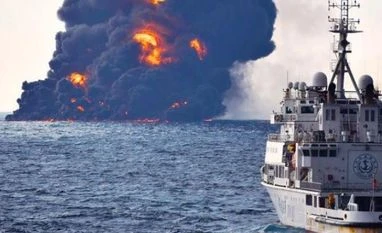
Iranian oil tanker
Iranian oil tanker
Steven Lee Myers and Javier C. Hernández | NYT
Last Updated : Feb 14 2018 | 1:04 AM IST
A fiery collision that sank an Iranian tanker in the East China Sea a month ago has resulted in an environmental threat that experts say is unlike any before: An almost invisible type of petroleum has begun to contaminate some of the most important fishing grounds in Asia, from China to Japan and beyond.

It is the largest oil spill in decades, but the disaster has unfolded outside the glare of international attention that big spills have previously attracted. That is because of its remote location on the high seas and also the type of petroleum involved: condensate, a toxic, liquid byproduct of natural gas production.

Unlike the crude oil in better-known disasters like the Exxon Valdez and the Deepwater Horizon, condensate does not clump into black globules that can be easily spotted or produce heart-wrenching images of animals mired in muck. There’s no visible slick that can be pumped out. Experts said the only real solution is to let it evaporate or dissolve. Absorbed into the water, it will remain toxic for a time, though it will also disperse more quickly into the ocean than crude oil.

Experts say there has never been so large a spill of condensate; up to 111,000 metric tons has poured into the ocean. It has almost certainly already invaded an ecosystem that includes some of the world’s most bountiful fisheries off Zhoushan, the archipelago that rises where the Yangtze River flows into the East China Sea.

The area produced five million tons of seafood of up to four dozen species for China alone last year, according to Greenpeace, including crab, squid, yellow croaker, mackerel and a local favorite, hairtail. If projections are correct, the toxins could soon make their way into equally abundant Japanese fisheries.

Exposure to condensate is extremely unhealthy to humans and potentially fatal. The effects of eating fish contaminated with it remain essentially untested, but experts strongly advise against doing so. “This is an oil spill of a type we haven’t seen before,” said Paul Johnston, a scientist at Greenpeace Research Laboratories at the University of Exeter in England. “Working out the impact is actually a huge task — probably next to impossible.”

For China, the disaster has become a test of its ambitions as a global and regional steward of the seas, especially at a time when it is reinforcing its territorial claims, including disputed territories with Japan in these waters. Given its proximity, China has taken the lead in investigating the disaster and monitoring the spill, but it has faced some criticism for what some see as a slow and inadequate response.

One subscription. Two world-class reads.

Already subscribed? Log in

Subscribe to read the full story →
*Subscribe to Business Standard digital and get complimentary access to The New York Times

Smart Quarterly

₹900

3 Months

₹300/Month

SAVE 25%

Smart Essential

₹2,700

1 Year

₹225/Month

SAVE 46%
*Complimentary New York Times access for the 2nd year will be given after 12 months

Super Saver

₹3,900

2 Years

₹162/Month

Subscribe

Renews automatically, cancel anytime

Here’s what’s included in our digital subscription plans

Exclusive premium stories online

  • Over 30 premium stories daily, handpicked by our editors

Complimentary Access to The New York Times

  • News, Games, Cooking, Audio, Wirecutter & The Athletic

Business Standard Epaper

  • Digital replica of our daily newspaper — with options to read, save, and share

Curated Newsletters

  • Insights on markets, finance, politics, tech, and more delivered to your inbox

Market Analysis & Investment Insights

  • In-depth market analysis & insights with access to The Smart Investor

Archives

  • Repository of articles and publications dating back to 1997

Ad-free Reading

  • Uninterrupted reading experience with no advertisements

Seamless Access Across All Devices

  • Access Business Standard across devices — mobile, tablet, or PC, via web or app

Next Story


