
Amy Coney Barrett cites 'Ginsburg rule' that Ginsburg didn't follow
It''s become a standard response by Republican high court nominees to recite Ginsburg''s words from her own confirmation hearing
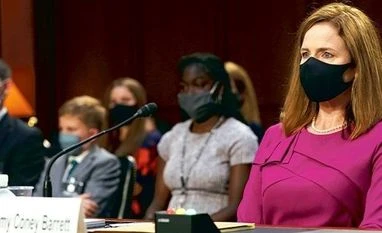 "Amy Coney Barrett cites 'Ginsburg rule' that Ginsburg didn't follow")
Explore Business Standard
It''s become a standard response by Republican high court nominees to recite Ginsburg''s words from her own confirmation hearing
Supreme Court nominee Amy Coney Barrett invoked Justice Ruth Bader Ginsburg at her Senate confirmation hearing Tuesday in refusing to discuss her view of gay rights and the Constitution.
Justice Ginsburg with her characteristic pithiness used this to describe how a nominee should comport herself at a hearing. No hints, no previews, no forecasts.
That had been the practice of nominees before her. But everybody calls it the Ginsburg rule because she stated it so concisely, Barrett said of the woman whose seat she would take if confirmed.
It's become a standard response by Republican high court nominees to recite Ginsburg's words from her own confirmation hearing.
Ginsburg, who died last month, did utter those words 27 years ago, saying A judge sworn to decide impartially can offer no forecasts, no hints for that would show not only disregard for the specifics of the particular case, it would display disdain for the entire judicial process.
But she also said much more on a range of hotly debated issues, including abortion, that went well beyond the rule that bears her name.
Here's Ginsburg on abortion in 1993, shortly before the Senate voted 96-3 to confirm her: The decision whether or not to bear a child is central to a woman's life, to her well-being and dignity. It is a decision she must make for herself.
When Government controls that decision for her, she is being treated as less than a fully adult human responsible for her own choices.
Barrett, who has signed ads opposing abortion and belonged to Notre Dame University's Faculty for Life, has refused to answer senators' questions on Roe v. Wade, the 1973 landmark Supreme Court ruling that declared a woman's right to an abortion.
Barrett's nomination is on a fast track since her nomination by President Donald Trump just over two weeks ago. Trump and Senate Republicans have said they want her on the court before Election Day, Nov. 3.
(Only the headline and picture of this report may have been reworked by the Business Standard staff; the rest of the content is auto-generated from a syndicated feed.)
First Published: Oct 14 2020 | 12:23 AM IST

