Arnold Palmer, the champion golfer whose full-bore style of play, thrilling tournament victories and magnetic personality inspired an American golf boom, attracted a following known as Arnie's Army and made him one of the most popular athletes in the world, died on Sunday evening in Pittsburgh. He was 87.
Doc Giffin, a spokesman for Palmer's business interests, said the cause was complications of heart problems. Paul Wood, a spokesman for the University of Pittsburgh Medical Centre, said Palmer died at UPMC Shadyside Hospital, about 40 miles from Palmer's home in Latrobe, Pennsylvania.
From 1958 through 1964, Palmer was the charismatic face of professional golf and one of its dominant players. In those seven seasons, he won seven major titles: four Masters, one United States Open and two British Opens. With 62 victories on the PGA Tour, he ranks fifth, behind Sam Snead, Tiger Woods, Jack Nicklaus and Ben Hogan. He won 93 tournaments worldwide, including the 1954 United States Amateur.
But it was more than his scoring and shotmaking that captivated the sports world. It was how he played. He did not so much navigate a course as attack it. If his swing was not classic, it was ferocious: He seemed to throw all 185 pounds of his muscular 5-foot-10 body at the ball. If he did not win, he at least lost with flair.
Handsome and charming, his sandy hair falling across his forehead, his shirttail flapping, a cigarette sometimes dangling from his lips, Palmer would stride down a fairway acknowledging his army of fans with a sunny smile and a raised club, "like Sir Lancelot amid the multitude in Camelot," Ira Berkow wrote in The New York Times.
And the television cameras followed along. As Woods would do more than 30 years later, Palmer, a son of a golf pro at his hometown Latrobe Country Club, almost single-handedly stimulated TV coverage of golf, widening the game's popularity among a postwar generation of World War II veterans enjoying economic boom times and a sprawling green suburbia.
His celebrated rivalry with Nicklaus and another champion, the South African Gary Player - they became known as the Big Three - only added to Palmer's appeal, and more often than not, he, not the others, had the galleries on his side.
"Arnold popularised the game," Nicklaus said. "He gave it a shot in the arm when the game needed it."
Hitching up his pants as he marched down the fairways or before lining up a crucial putt, Palmer put the word "charge" into golf's vocabulary in 1960. In the final round of that year's Masters, he birdied the 17th and 18th holes to win by one stroke. Two months later, in the United States Open at Cherry Hills, near Denver, he shot a final-round 65 to win by two over Nicklaus.
"I seem to play my best in a big tournament," Palmer said. "For one thing, my game is better adapted to the tougher courses. For another, I can get myself more keyed up when an important title is at stake. I like competition - the more rugged, the better."
And if he lost, his army did not desert him. In the 1961 Los Angeles Open at Rancho Park, he recorded a 12 on the par-5 ninth hole when he hit four balls out of bounds. Palmer's fans were deflated, like him, but somehow his flubs enhanced his appeal. He was human; he could blow a lead or a shot like any duffer. And they liked that he went down swinging, with his lunging, go-for-broke play.
If he hit a wayward tee shot to an awkward spot, he usually went for the green, rather than chip the ball safely back to the fairway, as other golfers would have done.
"You can make mistakes when you're being conservative, so why not go for the hole?" he said. "I always feel like I'm going to win. So I don't feel I'm gambling on a lot of shots that make other people feel I am."
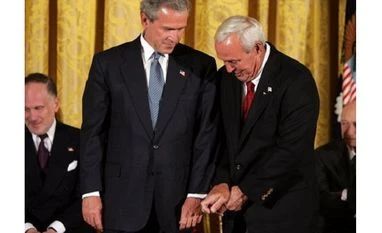
His nickname among tour pros was the King, although he never basked in the title. But it fit. He was the first athlete to receive three of the United States' civilian honors: the Presidential Medal of Freedom, the Congressional Gold Medal and the National Sports Award. And he became a one-man multimillion-dollar conglomerate.
As the president of Arnold Palmer Enterprises, he supervised the design and development of more than 300 new or remodeled golf courses worldwide, as well as golf clubs and clothing.
He popularized a drink known as the Arnold Palmer, a mixture of iced tea and lemonade now sold under his name on supermarket shelves.
He was a major fund-raiser for the Arnold Palmer Hospital for Children and Women in Orlando, Fla., and for Latrobe Hospital. He was the original chairman of cable television's Golf Channel and a longtime corporate spokesman, notably in a Pennzoil commercial featuring a tractor he had driven growing up on the Latrobe golf course.
After buying his first plane, a used twin-prop Aero Commander, for $27,000 in 1962, he became one of the first golf pros to pilot his own plane from tournament to tournament. He graduated to jets in 1966. The Latrobe airport is named for him.
With two co-pilots and an observer, he circumnavigated the globe in 1976 in 57 hours 25 minutes 42 seconds, a world record for jets in the 17,600-to-26,400-pound category. He spent more than 20,000 hours in the cockpit.
©2016 The New York Times News Service

 "Arnold Palmer, the magnetic face of golf in the 1960s, dies at 87")


