Bangladesh builds one of world's largest refugee camps for 100,000 Rohingya

Simply finding enough empty ground to accommodate the refugees is a huge problem
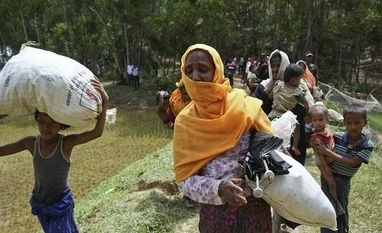
Members of Myanmar's Muslim Rohingya ethnic minority who were pushed back by Bangladeshi border guards earlier in the day rush back to the Bangladeshi side upon hearing gun shots from the Myanmar side in, Ghumdhum, Bangladesh. Photo: AP/PTI
Reuters
Last Updated : Oct 06 2017 | 9:00 AM IST
Hard-pressed to find space for a massive influx of Rohingya Muslim refugees, Bangladesh plans to chop down forest trees to extend a tent city sheltering destitute families fleeing ethnic violence in neighbouring Myanmar.

More than half a million Rohingya have arrived from Myanmar’s western state of Rakhine since the end of August in what the United Nations has called the world’s fastest-developing refugee emergency.

The exodus began after Myanmar security forces responded to Rohingya militants’ attacks on Aug. 25 by launching a brutal crackdown that the United Nations has denounced as ethnic cleansing.

Myanmar has rejected that accusation, insisting that the military action was needed to combat “terrorists” who had killed civilians and burnt villages.

But it has left Bangladesh and international humanitarian organisations counting the cost as they race to provide life-saving food, water and medical care for the displaced Rohingya.

Simply finding enough empty ground to accommodate the refugees is a huge problem.

“The government allocated 2,000 acres when the number of refugees was nearly 400,000,” Mohammad Shah Kamal, Bangladesh’s secretary of disaster management and relief, told Reuters on Thursday.

“Now that the numbers have gone up by more than 100,000 and people are still coming. So, the government has to allocate 1,000 acres (400 hectares) of forest land.”

Once all the trees are felled, aid workers plan to put up 150,000 tarpaulin shelters in their place.

Swamped by refugees, poor Bangladeshi villagers are faced with mounting hardships and worries, including the trafficking of illegal drugs, particularly methamphetamines, from Myanmar.

“The situation is very bad,” said Kazi Abdur Rahman, a senior official in the Bangladesh border district of Cox’s Bazar, where most of the Rohingya are settled.

“People in Cox’s Bazar are concerned, we are also concerned, but there’s nothing we can do but accommodate them.”

The pressure on the land is creating another conflict, this time environmental rather than ethnic.

Last month, wild elephants trampled two refugees to death and Rahman said more such encounters appeared inevitable as more forest is destroyed.

OVER A MILLION PEOPLE IN NEED

U.N. agencies coordinating aid appealed on Wednesday for $434 million to help up to 1.2 million people, most of them children, for six months.

Their figure includes the 515,000 who have arrived since August, more than 300,000 Rohingya who were already in Bangladesh, having fled earlier suppression, a contingency for another 91,000 and 300,000 Bangladesh villagers in so-called host communities who also need help.

The Save the Children aid group warned of a malnutrition crisis with some 281,000 people in need of urgent nutrition support, including 145,000 children under five and more than 50,000 pregnant and breastfeeding women.

“In over 20 years as a humanitarian worker, I’ve never seen a situation like this, where people are so desperate for basic assistance and conditions so dire,” Unni Krishnan, director of Save the Children’s Emergency Health Unit, said in a statement.

U.N. agencies are wary of planning beyond six months for fear or creating a self-perpetuating crisis.

Myanmar has promised to take back anyone verified as a refugee but there’s little hope for speedy repatriation.

There is long-simmering communal tension and animosity towards the Rohingya in Myanmar, most of whom are stateless and derided as illegal immigrants.

“This crisis isn’t going to end soon,” said a Bangladeshi interior ministry official who declined to be identified.

One subscription. Two world-class reads.

Already subscribed? Log in

Subscribe to read the full story →
*Subscribe to Business Standard digital and get complimentary access to The New York Times

Smart Quarterly

₹900

3 Months

₹300/Month

SAVE 25%

Smart Essential

₹2,700

1 Year

₹225/Month

SAVE 46%
*Complimentary New York Times access for the 2nd year will be given after 12 months

Super Saver

₹3,900

2 Years

₹162/Month

Subscribe

Renews automatically, cancel anytime

Here’s what’s included in our digital subscription plans

Exclusive premium stories online

  • Over 30 premium stories daily, handpicked by our editors

Complimentary Access to The New York Times

  • News, Games, Cooking, Audio, Wirecutter & The Athletic

Business Standard Epaper

  • Digital replica of our daily newspaper — with options to read, save, and share

Curated Newsletters

  • Insights on markets, finance, politics, tech, and more delivered to your inbox

Market Analysis & Investment Insights

  • In-depth market analysis & insights with access to The Smart Investor

Archives

  • Repository of articles and publications dating back to 1997

Ad-free Reading

  • Uninterrupted reading experience with no advertisements

Seamless Access Across All Devices

  • Access Business Standard across devices — mobile, tablet, or PC, via web or app

Next Story


