
Bank of England hints at faster rate hikes, but post-Brexit options open
A disruptive Brexit would probably cause sterling to fall and push up inflation
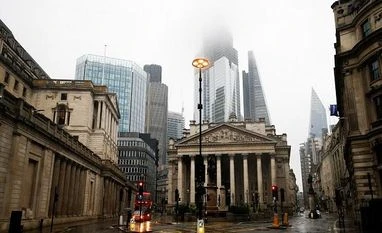 "Bank of England hints at faster rate hikes, but post-Brexit options open")
Explore Business Standard
A disruptive Brexit would probably cause sterling to fall and push up inflation
The Bank of England hinted at slightly faster future rises in interest rates if Brexit goes smoothly, but warned all bets were off if next March brought a "disruptive" departure from the EU.
The BoE's nine rate-setters voted unanimously to hold rates at 0.75 percent on Thursday, as expected by economists in a Reuters poll, after raising them in August for only the second time since before the financial crisis.
Bank of England Governor Mark Carney said a disruptive no-deal Brexit was not the central bank's main assumption but if there was a shock to the economy, it was not possible to say if rates would need to rise or fall in response.
Brexit is dominating the outlook for the world's fifth-largest economy, which has seen growth slow since the referendum decision in June 2016 to leave the European Union. Most economists do not expect rates to rise again until mid-2019.
"Since the nature of EU withdrawal is not known at present, and its impact on the balance of demand, supply and the exchange rate cannot be determined in advance, the monetary policy response will not be automatic and could be in either direction," Carney told a news conference.
The BoE cut interest rates and ramped up its bond-buying programme after the shock referendum vote, but Carney cautioned against assuming it would do the same in the event of a no-deal Brexit.
One option, he said, would be to extend the horizon for returning inflation to the BoE's target, a measure which would suggest slower interest rates hikes.
A disruptive Brexit would probably cause sterling to fall and push up inflation. Combined with a hit to supply chains and possible trade tariffs, that would argue for raising rates.
The BoE said policymakers would need to balance the hit to growth from lost trade, uncertainty and tighter financial conditions. That would normally make a case for lower rates.
Sterling rose modestly against the dollar after the BoE policy announcement to hit a day's high. It later fell back to show almost no change from before the statement.
"November's statement makes it pretty clear the Bank of England would like to be hiking rates further," James Smith, an economist at bank ING, said.
"But given that it may be quite some time before we know for sure that a no-deal Brexit has been avoided, we suspect policymakers will struggle to hike rates before May 2019 at the earliest."
CONSUMERS RESILIENT, BUSINESSES NERVOUS
The BoE said consumer spending performed better than it had expected but businesses were holding back on investment until there was clarity about Brexit.
Prime Minister Theresa May has yet to secure a transition deal to ease Britain's exit from the EU.
There has been progress towards an agreement giving London's dominant financial centre basic access to EU markets, two British officials said on Thursday.
Assuming Brexit goes smoothly, the economy was likely to continue to grow by around 1.75 percent a year, the BoE said.
This is some way below the rate of above 2 percent that was typical before Britain voted to leave the EU, but the BoE said the economy was at full capacity and inflation would take three years to drop from 2.4 percent now to its 2 percent target.
The economy was expected to start running above capacity late next year, sooner than the BoE had forecast in August, creating inflation pressure.
The BoE's inflation worry comes despite it pencilling in almost three quarter-point interest rate rises over the next three years, compared with just over two in forecasts that accompanied August's rate rise.
The assumptions are based on market pricing, but they give some indication of how fast the BoE thinks borrowing costs will need to rise.
Carney, asked by a reporter whether financial markets had priced in enough rate hikes, pointed to the BoE's forecast that inflation would be a bit above its target in two years' time.
That suggested he thought investors were being a bit too cautious about the pace of rate hikes.
Despite the lack of slack in the economy and recent faster-than-expected rises in wages, the BoE's kept its medium-term pay forecasts unchanged, seeing growth of 3.25 percent by the end of next year and 3.5 percent in late 2020.
First Published: Nov 01 2018 | 7:30 PM IST


