China’s Belt and Road Initiative (BRI), articulated by President Xi Jinping in 2013, is recognised as the largest infrastructure and investment project in global history. Spanning 68 countries, including 65 per cent of the world’s population and 40 per cent of global GDP, it is popularly considered an ambitious blueprint for Chinese global hegemony. The BRI’s lumpy progress, however, has also provoked predictions of its imminent demise. Talk to senior members of the Chinese establishment and they’re equivocal about the first point and flatly contradict the second.
As of November 2019, Hu Biliang, dean of the Belt and Road Institute at Beijing Normal University, estimates that China will pour in $10 trillion of funds into the projects in the next decade. By comparison, the 11 multilateral institutions have a combined purse of less than $2 trillion ($1,723 billion) for the same period. Hu says the Chinese government has already spent $40 billion for BRI-related projects.
Yet BRI is much more than rushing through a bunch of infrastructure projects, says Zhang Weiwei, professor of international relations at Fudan University, Beijing. It is more about “setting a sense of priorities. You set the compass first and then build a road”. Zhang has been by turns a visiting professor at the Graduate Institute of International and Development Studies, and at the Geneva School of Diplomacy and International Relations. His CV includes assignments as speech writer for Deng Xiaoping and now Xi, which means unparalleled access to the minds of the men who have shaped China’s policy. He surprised Francis Fukuyama during a debate on the Arab Spring a decade ago, saying it would soon turn into an Arab Winter. He now says Great Britain post-Brexit is on its way to becoming a Little Britain.
According to him, the Chinese concept is to build new points of growth that would “shape up as an irresistible force”. The West has understood BRI as a game of chess among competing nations for economic supremacy. It is not so, he insists. It is like Weiqi, a Chinese strategy board game — which, incidentally, aims to surround more territory than opponents but where the loser also shares the spoils.
Six years after it was articulated, BRI is a way of life for the Chinese government, the party and all Chinese companies such as China Civil Engineering and Construction Company, which claims a presence in 89 countries. Every one of its project is now potentially a BRI project, it notes, which “provides new models of international cooperation”. The company also has a presence in India. The country has begun to hold international symposiums with titles such as “Significance of China’s Social Governance to the World”. The ambitions are transparent.
That ambition, according to Qi Zhenhong, President of the premier think tank China Institute of International Studies, is to “construct a common human destiny of the world, that of shared prosperity”. This is unexceptionable when set against the shared poverty fostered by colonialism in the 19th and 20th centuries. Then, he adds that the goal of shared prosperity can be best achieved through the adoption of BRI. And BRI is not roads and power stations but a common governance model, both political and digital.
All senior officials are dismissive of the controversies over migration in Europe and the USA, which, they say, make multilateralism a casualty. “World affairs should not be faced by single nations,” Qi argues. He does not answer whether the BRI concept was vetted through any international forum, except those called for by China. “We shall not expand territory (but) espouse a common sense of strategic stability,” he intones. He describes BRI as a public commons provided for the world by China, which includes other than infra elements of energy, climate, anti-poverty, food and health security besides cyber security.
It is on cyber-security that Chinese experts make clear where they want the rest of the world to head. Zhang says the internet revolution is unstoppable. But “it cannot be used for freedom of expression. It is meant to help people to use it to earn their livelihood”. When it is used without this caveat, unpleasant things such as the Arab Springs happen. In Beijing and elsewhere in China, most global social media platforms are absent and even Indian government sites take time to load.
Of course, there is some good stuff in BRI. Beijing wants to export its Two Mountain theory — a line of thought from Xi that equates clear waters and lush mountains as assets of today comparable to those from gold and silver of yesteryear, a strong pro-environment position. Gu Xueming, dean of the Chinese Academy of International Trade and Economic Cooperation uses this as an example to establish that BRI is an economic imperative not a geopolitical clique.
And what about the obvious sovereign concerns for India because of the China Pakistan Economic Corridor that runs through parts of Jammu & Kashmir. As Qi adds colourfully: “Bad intentioned people in international community are hoping something bad happens between India and China. BRI may not be the only path but one of the paths.”
The author was in China recently at the invitation of the Communication University of China

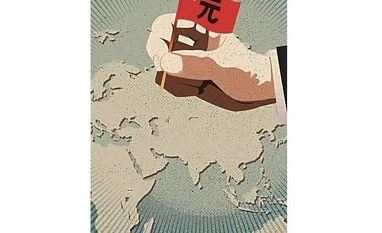 "Belt and Road Initiative: 'China's social governance of the world'")











