Home / World News / China angered as US Senate passes bill to promote close ties with Taiwan
China angered as US Senate passes bill to promote close ties with Taiwan
Chinese foreign ministry spokeswoman Hua Chunying said that while some of the new bill's provisions are not legally binding, it "seriously violates" the One China principle
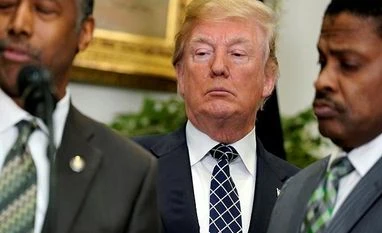
US President Donald Trump stands between US Secretary of Housing and Urban Development Ben Carson (left) and Issac Newton Farris before signing a proclamation to honour Martin Luther King Jr day on Friday
China lodged an official protest with the United States today, saying it was "strongly dissatisfied" after the US Senate passed a bill promoting relations with self-governing Taiwan.
The US Senate passed the Taiwan Travel Act, intended to encourage visits between the United States and Taiwan "at all levels", by unanimous consent on Wednesday, following its approval in the House of Representatives in January.
The bill adds that it should be US policy for high-level Taiwanese officials to enter the United States, meet with US officials and conduct business in the country.
President Donald Trump's signature is now all that is needed for the bill to become law -- something that is not likely to be an obstacle, given that the bill was passed unanimously.
Washington cut formal diplomatic ties with Taiwan in 1979, recognising the Communist mainland rulers in Beijing as the sole government of "One China."
Chinese foreign ministry spokeswoman Hua Chunying said that while some of the new bill's provisions are not legally binding, it "seriously violates" the One China principle.
"China is strongly dissatisfied and firmly opposes it," Hua told a regular news briefing, adding that Beijing had made "solemn representations" to the US -- a diplomatic protest.
The United States, she said, should stop official exchanges with Taiwan and handle Taiwan issues "prudently and properly" to avoid "damaging Sino-US relations".
Under the terms of the 1979 Taiwan Relations Act, Washington maintains an ambiguous approach to the island, maintaining trade relations and selling Taipei weapons.
Trump sparked protest from China shortly after his election in 2016 by accepting a phone call from Taiwan's leader Tsai Ing-wen, an action seen as breaking the protocol of the One China policy.
He made amends by vowing to uphold the One China policy shortly before Chinese President Xi Jinping's visit to his Florida Mar-a-Lago resort -- but infuriated Beijing again last summer by approving a USD 1.3 billion arms sale to Taiwan.

 "China angered as US Senate passes bill to promote close ties with Taiwan")

