
China set to sell its first negative-yielding government bond worth $887 mn
The three-part deal also consisted of a 2 billion euro 10-year bond priced at 55 bps over the mid-swap rate
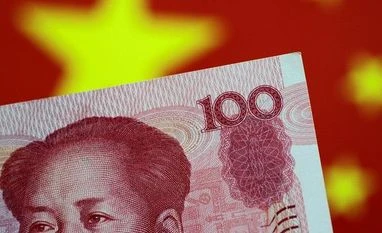 "China set to sell its first negative-yielding government bond worth $887 mn")
WebinarsNew
Deep DiveNew
Explore Business Standard
The three-part deal also consisted of a 2 billion euro 10-year bond priced at 55 bps over the mid-swap rate
By Hongwei Li and Marc Jones
BEIJING/LONDON (Reuters) - China was set to sell its first negative-yielding government bond on Wednesday, becoming the latest to benefit from this year's plunge in interest rates in the COVID-19 pandemic.
Beijing was poised to sell a 750 million euro ($887.93 million) 5-year bond that, at 30 basis points (bps) above the so-called mid-swap rate of -0.45%, effectively offered investors a -0.15% interest rate.
The three-part deal also consisted of a 2 billion euro 10-year bond priced at 55 bps over the mid-swap rate and a 1.25 billion euro 15-year issue priced at 70 bps over the mid-swap rate, according to a document from a lead manager of the deal.
"Negative yields are part of an overall global trend now," said Daniel Moreno, head of emerging markets debt at Mirabaud, adding there was now roughly $17 trillion worth of sub-zero debt globally. "I think we are going to see much more of this".
Global interest rates have been pushed to record lows by the coronavirus crisis. Nearly all short- and medium-term euro zone government debt now carry negative rates, meaning investors effectively pay to hold it.
China has been steadily building its capital markets in recent years. Offering bonds in alternative currencies to the yuan or U.S. dollar is seen as an important part of that process.
The deal also comes amid a rush of demand for emerging-market debt following this month's COVID-19 vaccine breakthroughs and U.S. election win for Democrat Joe Biden, which has lifted hopes that U.S.-China trade tensions will ease.
U.S. President Donald Trump's administration imposed new sanctions on China just last week. They effectively stop U.S.-based investors from buying the debt or shares of a number of Chinese companies.
China's finance ministry did not immediately respond to a request for comment on Wednesday's bond sale.
The deal follows a similar offering a year ago when Beijing sold its first euro-denominated government debt in 15 years. It also follows a $6 billion U.S. dollar bond sale last month which saw strong.
($1 = 0.8447 euros)
(Reporting by Hongwei Li in Beijing and Marc Jones in London; Additional reporting by Tom Arnold and Abhinav Ramnarayan in London and Andrew Galbraith in Shanghai; Editing by Mark Potter and Christopher Cushing)
(Only the headline and picture of this report may have been reworked by the Business Standard staff; the rest of the content is auto-generated from a syndicated feed.)
First Published: Nov 19 2020 | 7:51 AM IST


 Connect with us on WhatsApp