Comparing Trump, Xi at G20 summit: China seems a safe bet for investors

How should investors position themselves when the world's two largest economies look like they are from two planets?
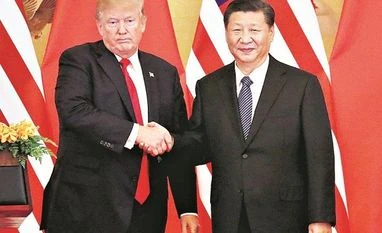
US President Donald Trump with Chinese counterpart Xi Jinping on the sidelines of the G20 summit | File Photo: Reuters
The meeting in Washington comes weeks before US President Donald Trump is expected to meet his Chinese counterpart Xi Jinping on the sidelines of the G20 summit | File Photo: Reuters
Bloomberg
Last Updated : Dec 05 2018 | 2:37 PM IST
The US is from Mars, China is from Venus – or at least, that’s the impression left by last weekend’s Group of 20 summit. 

Markets this week whipsawed as they digested the high-level dinner between President Donald Trump and his Chinese counterpart Xi Jinping. A direct side-by-side comparison of the two statements that came out of that meeting couldn’t have looked more different, and investors have started to fret that Trump had overstated his successes, again. As of Wednesday morning, all we have from the Chinese is a vague acknowledgement that there is indeed a consensus that the two sides will restart trade talks within 90 days. Little concrete came about.

How should investors position themselves when the world’s two largest economies look like they are from two planets? I would take Venus’s side. Emerging markets, including China, are now the safer bet. 

Since 2016, the S&P 500 Index’s performance has closely tracked analysts’ earnings expectations, but that relationship started to break down in October. With trade frictions and rising wages on the horizon, and a yield curve about to invert – an indicator widely regarded as a prelude to a recession – investors now suspect the sell-side is being too optimistic.

In November, globally, there were 1.7 downgrades for every upgrade by analysts, data provided by Bank of America Merrill Lynch show. Brokers in the US, on the other hand, are just getting started, with 0.9 downgrades for each upgrade. It might be better to sell now before analysts ax their numbers. 

In addition, for dollar-based investors the money market is becoming a viable alternative to stocks and bonds, with very low risk and a real yield at last. Three-month Libor is now promising 2.75 per cent, above the 2.5 per cent consumer price inflation rate. Holding onto cash while waiting to see what happens is a winning strategy. 

An inverted yield curve for emerging markets, in this case, is almost welcome. As I argued last week, emerging markets suffered this year in part because the US has been growing at the speed of a developing nation, without the associated currency or governance risks. But if a recession is looming in the US, smart money will move south again, in hope of some mean reversion. 

The key lesson we learned over the last two years is that earnings matter. Emerging markets outperformed in 2017 because of sharply improved earnings, only to be caught up by the US this year as the Trump administration’s tax cut supercharged the US economy.

But the effect of the tax cut is waning, and Trump looks to have used up his toolbox at the wrong time. China could still pass some further monetary and fiscal stimulus as we head into a crucial period for the trade negotiations next year. 

The Ministry of Finance does its budget calculations at the end of the calendar year and announces the government’s GDP growth and fiscal targets after the Lunar New Year, which falls in early February in 2019. As a result, the 90-day time-out on the next round of talks agreed in Buenos Aires will give Beijing just enough time to figure out how much firepower it has for the next round of discussions.

If Trump wants to emerge from that process as the winner, better communication skills are the least of his worries.

One subscription. Two world-class reads.

Already subscribed? Log in

Subscribe to read the full story →
*Subscribe to Business Standard digital and get complimentary access to The New York Times

Smart Quarterly

₹900

3 Months

₹300/Month

SAVE 25%

Smart Essential

₹2,700

1 Year

₹225/Month

SAVE 46%
*Complimentary New York Times access for the 2nd year will be given after 12 months

Super Saver

₹3,900

2 Years

₹162/Month

Subscribe

Renews automatically, cancel anytime

Here’s what’s included in our digital subscription plans

Exclusive premium stories online

  • Over 30 premium stories daily, handpicked by our editors

Complimentary Access to The New York Times

  • News, Games, Cooking, Audio, Wirecutter & The Athletic

Business Standard Epaper

  • Digital replica of our daily newspaper — with options to read, save, and share

Curated Newsletters

  • Insights on markets, finance, politics, tech, and more delivered to your inbox

Market Analysis & Investment Insights

  • In-depth market analysis & insights with access to The Smart Investor

Archives

  • Repository of articles and publications dating back to 1997

Ad-free Reading

  • Uninterrupted reading experience with no advertisements

Seamless Access Across All Devices

  • Access Business Standard across devices — mobile, tablet, or PC, via web or app

Next Story



