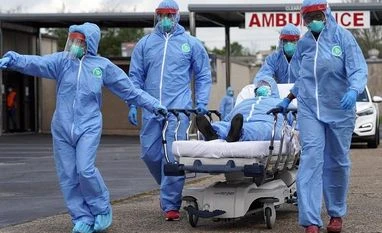
New York, the coronavirus pandemic’s epicentre in the United States, has more coronavirus cases than any country and accounts for around half of all deaths in the US. Covid-19 has torn through New York with a frightening speed. Why was it so badly hit and could its leaders have done anything differently?
In New York, the cumulative death toll is higher than the fatalities suffered from 9/11, when nearly 3,000 people were killed in the terror attack on the US. By comparison, as of Friday,
New York state had almost 160,000 confirmed
Covid-19 infections, more than Europe's worst-hit countries of Spain and Italy, and over 7,800 deaths.
According to Mayor Bill de Blasio, New York is in an “extraordinary race against time".
"We’re dealing with an enemy that is killing thousands of Americans, and a lot of people are dying who don’t need to die,” he said. “You can’t say, every state for themselves, every city for themselves. That is not America", said Blasio.
American geneticists estimate that it started spreading there from Europe in February, before New York's first confirmed case on March 1. The Big Apple is also characterized by massive socioeconomic inequality.
Americans, almost all of them under orders to stay home except for essential outings such as grocery shopping or seeing a doctor, have heard conflicting guidance in recent days about the need for wearing face masks in public.
Overcrowded, deprived areas -- particularly in the Bronx and Queens, where many people already suffer health problems and lack medical care -- have experienced the highest rate of infections.
"New York City had all the preconditions that would support the idea that it was going to be hit very hard," said Irwin Redlener, public health professor and expert in disaster preparedness at Columbia University.
On March 2, as the state's second case was confirmed in New Rochelle, just north of New York City, Cuomo said the health care system was the best "on the planet."
"We don't even think it's going to be as bad as it was in other countries," he added.
After much hesitation, New York City Mayor Bill de Blasio announced the closure of public schools, bars and restaurants from March 16. The governor ordered all non-essential businesses to close and residents to stay at home a week later on March 22.
Experts hesitate to say that they waited too long.
"The mayor and the governor were being pushed and pulled by two opposing forces.
"One was saying we have to close schools and restaurants as quickly as possible, the other saying there were lots of economic and social consequences of shutting down everything early," said Redlener.
"Everyone was getting mixed messages, including from the federal government, from (President Donald) Trump," he added.
California, America's most populous state, is often cited as a good example for the speed of its response to the outbreak. Its confirmed cases as of Friday were just 20,200, with 550 deaths. On March 16, six counties in the San Francisco Bay area issued a stay-at-home order followed by the whole state three days later.
"One thing that I think is significant is that six neighboring counties got together and issued the same (confinement) order for all six counties, and they did it early," said Meghan McGinty, associate at school of public health of Johns Hopkins University.
"There was consistency, as opposed to NYC taking one measure, and Westchester (county) taking another, and Long Island taking another," she told AFP.
Six days passed between New York's school closure order and its order confining residents to their homes.
"In epidemic terms, six days is light years and can really make a difference in the control and spread of the epidemic, so I think it is possible to say that perhaps, in retrospect, New York waited too long," said McGinty.
When the crisis passes, the blame game may begin. Democrats Cuomo and de Blasio deplored for weeks the Trump administration's delay in getting tests to states, which to this day are still not arriving in sufficient numbers. The New York officials also targeted the federal government for dragging its heels in implementing emergency powers to manufacture lifesaving ventilators.
With the toll far exceeding the numbers killed on 9/11, Phil Murphy, the governor of neighboring New Jersey, which has also been badly affected, has called for a commission similar to the one set up to investigate the September 11, 2001 attacks.

 "Covid-19: What made New York a breeding ground for coronavirus infections")









