'Dear Olaf': France's Macron welcomes new German chancellor

Both played down potential differences over green investment rules, EU budget
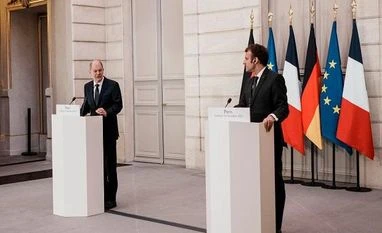
Macron, Olaf Scholz
French President Emmanuel Macron gestures as he stands next to German Chancellor Olaf Scholz during a news conference at the Elysee Palace in Paris (Photo: Reuters)
Michel Rose and Sabine Siebold | Reuters Paris
3 min read Last Updated : Dec 10 2021 | 9:22 PM IST
French President Emmanuel Macron and Germany's new Chancellor Olaf Scholz played down differences on Friday over reform of EU budget rules and the place of nuclear in green investment financing, pledging to keep the Franco-German axis strong

The trip to meet Macron in Paris was Scholz's first foreign visit since he became German leader on Wednesday, ending 16 years of rule by Angela Merkel. Diplomats say the change presents Macron with an opportunity to seize a more senior role in the Franco-German relationship.

"During the last four years I have worked with Angela Merkel on all these subjects ... I know that we will continue together, dear Olaf, this close collaboration," Macron told Scholz at a joint news conference.

The more reserved Scholz, whose three-party coalition has pledged to further strengthen European integration, said they had talked about how to work together to make Europe stronger.

Arriving at the Elysee palace, the new chancellor was greeted with a fistbump by Macron, who then accompanied him up the steps, patting him on the back.

The French president had developed a friendly relationship with Merkel, who broke with German tradition by backing unprecedented joint European Union efforts to raise debt during the COVID-19 pandemic. But the two remained at odds over some key issues, including Germany's gas imports from Russia, defence, and relationships with big political and economic competitors including China.

The size of Germany's economy, the biggest in the 27-nation EU, gives any German chancellor outsized influence. But Macron, who said Merkel had "taught much" to the "impetuous president" he was at the start, will try to use France's six-month presidency of the EU, which starts on Jan. 1, to advance his priorities while Scholz is finding his feet.

With fiscal discipline often a point of dispute between Paris and Berlin, and Macron seeking Germany's support for his plans to overhaul EU budget rules, Scholz - formerly Merkel's finance minister - was cautious on Friday.

"AMBITIOUS"

"I am confident that we can solve the problems ahead of us together and that we can continue to enable the growth that we fostered with the recovery fund - and that at the same time we can ensure solid finances," he said, referring to the 750 billion euros the EU will use to support the pandemic recovery.

"It is possible to achieve both at the same time - they are not opposites. We have promised to use the flexibility that the (EU's) Stability and Growth Pact offers." While the two leaders were united in offering verbal support to Ukraine over Russia's troop build-up, other point of divergence emerged, including on nuclear energy.

Macron wants to build new nuclear reactors in France, while Germany's plans to phase them out are well established. The new German coalition agreement makes no mention of the issue, however, which Paris believes leaves room for compromise.

Asked on Friday about differences between Germany and France over whether nuclear power should be labelled sustainable, which France wants, Scholz skirted the question.

"It is very clear that each country pursues its own strategy to fight man-made climate change. What unites us is that we recognise that responsibility and are ambitious," he said.

"Germany has decided that it will bank on an expansion of renewable energy."

French diplomats appear optimistic about the outlook for ties with Germany under Scholz, citing "strategic sovereignty" in the coalition deal that took him to power, which they say echoes Macron's push for European "strategic autonomy".

One subscription. Two world-class reads.

Already subscribed? Log in

Subscribe to read the full story →
*Subscribe to Business Standard digital and get complimentary access to The New York Times

Smart Quarterly

₹900

3 Months

₹300/Month

SAVE 25%

Smart Essential

₹2,700

1 Year

₹225/Month

SAVE 46%
*Complimentary New York Times access for the 2nd year will be given after 12 months

Super Saver

₹3,900

2 Years

₹162/Month

Subscribe

Renews automatically, cancel anytime

Here’s what’s included in our digital subscription plans

Exclusive premium stories online

  • Over 30 premium stories daily, handpicked by our editors

Complimentary Access to The New York Times

  • News, Games, Cooking, Audio, Wirecutter & The Athletic

Business Standard Epaper

  • Digital replica of our daily newspaper — with options to read, save, and share

Curated Newsletters

  • Insights on markets, finance, politics, tech, and more delivered to your inbox

Market Analysis & Investment Insights

  • In-depth market analysis & insights with access to The Smart Investor

Archives

  • Repository of articles and publications dating back to 1997

Ad-free Reading

  • Uninterrupted reading experience with no advertisements

Seamless Access Across All Devices

  • Access Business Standard across devices — mobile, tablet, or PC, via web or app

Topics :Emmanuel MacronGermanyFrance

Next Story



