Home / World News / European relief as Dutch snub 'siren song' of far-right
European relief as Dutch snub 'siren song' of far-right
Rutte's Liberal VVD party was seen as emerging as largest party for third time running with 33 seats
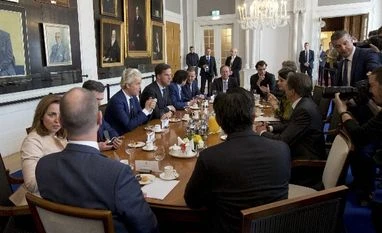
Political party leaders meet with the chairwoman of the parliament to discus first steps in forming a new dutch coalition government in The Hague, Netherlands
European leaders breathed a sigh of relief on Thursday as the pragmatic Dutch plumped for the status-quo, voting Liberal Prime Minister Mark Rutte back into power even though the far-right shot up into second place.
"A vote for Europe, a vote against extremists," Margaritis Schinas, spokesman for EU Commission chief Jean-Claude Juncker, said in a Tweet.
After the Brexit blow and Donald Trump's victory in the US, yesterday's general elections was being closely watched across a continent seeking to take the temperature of the rise of populism.
It was "a victory for common sense and a great start for Europe's election season," said Holger Schmieding, chief economist with Berenberg bank.
The fact that most Dutch voters had "rebuked the siren songs of the populists may help a little" with upcoming polls in France and Germany, he said.
After flirting for some months with putting anti-Islam MP Geert Wilders at the helm of the country of 17 million people, in the end Dutch voters opted for stability.
With 93 per cent of votes counted, Rutte's Liberal VVD party was seen as emerging as the largest party for the third time running with 33 seats, the Dutch news agency said.
That is eight seats down on the last elections in 2012, but puts him in pole position to form the next coalition government to rule one of the largest eurozone economies.
The Netherlands had "said 'stop' to the wrong kind of populism," Rutte told cheering supporters late yesterday.
The next task was "to unite the country ... (and) succeed in forming a stable government for the next four years."
Wilders however had reason to crow, having boosted his number of seats to 20 from 15 in the last election, according to the ANP count.
"We were the 3rd largest party of the Netherlands. Now we are the 2nd largest party. Next time we will be nr. 1!" he tweeted.
But Rutte is unlikely to ask Wilders and his anti-EU Freedom Party (PVV) to join him in coalition, having been stabbed in the back in 2012 when the MP withdrew his support for the government over austerity talks, forcing snap elections.
All the top party leaders were due to gather for the first time at the centuries-old Dutch parliament later today to "give their opinions on how the new cabinet can be formed," the parliamentary press office said.
"The fascination for the rise of right-wing populism in Europe is over," said Hajo Funke, from the Otto Suhr political sciences institute, at Berlin's Free University.
"They see that the right-wing populism, as good as it was perceived against migrants, can destroy countries' economies and trigger a chain-reaction of destruction in Europe. (Reopens FGN 46)
Wilders adopted a conciliatory tone early today as he eyed the start of tough coalition talks.
"I would still like to co-govern as the PVV, if possible. But if that doesn't work ... We'll support the cabinet, where needed, on the issues that are important to us," he told reporters.
Rutte is more likely to turn natural coalition partners the Christian Democratic Appeal (CDA) and Democracy party D66 which shared joint third with 19 seats each.
Rutte plus the CDA and D66 would comprise 71 seats of the 76 needed for a parliamentary majority.
That means they would have to woo a fourth party for a centre-right coalition. Two contenders could be the Christian Union with five seats or the more orthodox Calvinist Reformed Political Party (SGP) which took three.
That would leave Wilders as the largest party in opposition, ensuring he will remain a thorn in the side of the establishment.
Joining him most likely in opposition will be his ideological foe Jesse Klaver who has turned around the fortunes of his ecologist, left-wing party GroenLinks.
The young charismatic leader appears to have drawn huge support among younger voters, and boosted his party from just four seats in parliament to 14.
"I think it will be difficult for them to negotiate about lot of issues but I think within a couple of months we will see a centre-right government being formed with these results," Leiden University analyst Geerten Waling told AFP.
"With this election there is absolutely no reason to think that there is a political crisis in the Netherlands.

 "European relief as Dutch snub 'siren song' of far-right")

