Home / World News / From vaccines to climate, G7 hopes to show the West is not over yet
From vaccines to climate, G7 hopes to show the West is not over yet
The coronavirus ravaged the United States and Europe and climate change has challenged the assumptions of many of its economic models
premium
US President Joe Biden will try to use the three-day G7 summit in the English seaside village of Carbis Bay to burnish his multilateral credentials after the tumult of Donald Trump’s presidency Photo: Reuters
The Group of Seven rich democracies will try to show the world at a summit this week that the West can still act in concert to tackle major crises by donating hundreds of millions of Covid-19 vaccines to poor countries and pledging to slow climate change.
US President Joe Biden, on his first foreign trip since winning power, will try to use the summit in the English seaside village of Carbis Bay to burnish his multilateral credentials after the tumult of Donald Trump’s presidency.
Whether on Covid-19 or climate change, the leaders of Britain, Canada, France, Germany, Italy, Japan and the United States want to illustrate that the West can compete with the power of China and the assertiveness of Russia.
“This is a defining question of our time: Can democracies come together to deliver real results for our people in a rapidly changing world?” Biden, 78, asked in a June 5 opinion piece in The Washington Post.
“Will the democratic alliances and institutions that shaped so much of the last century prove their capacity against modern-day threats and adversaries? I believe the answer is yes.”
At the weekend, the G7’s finance ministers agreed a deal on a minimum corporate tax rate, which US Treasury Secretary Janet Yellen said reflected a desire to work together. “It shows that multilateral collaboration can be successful,” she said.
Biden meets British Prime Minister Boris Johnson, chair of the summit, on Thursday, the day before the start of the leaders' three-day meeting. On Sunday, Biden will become the 13th serving US President to meet Queen Elizabeth II, 95, who will receive him at Windsor Castle.
He then travels to Brussels for a Nato summit and a European Union summit before he meets Kremlin chief Vladimir Putin in Geneva on June 16.
The G7 was founded in 1975 as a forum for the richest nations to discuss crises such as the Opec oil embargo. Its countries have a combined annual GDP of $40 trillion, or just under half of the global economy.
The West, though, feels insecure. The coronavirus ravaged the United States and Europe and climate change has challenged the assumptions of many of its economic models. It faces a truculent Kremlin in Moscow and the spectacular re-emergence of China as a great power.
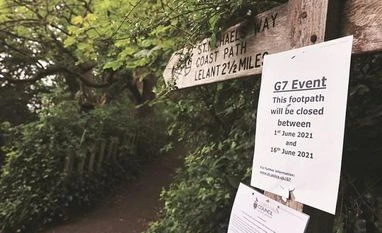
The G7 summit in Carbis Bay, 300 miles west of London, will be the first for Biden, Italy's Mario Draghi and Japan's Yoshihide Suga, and the first post-Brexit G7 for Johnson.
It will be Angela Merkel’s last G7 before she steps down as German Chancellor after an election in September, and Emmanuel Macron’s last before a 2022 election in France. The leaders of Australia, India, South Korea and South Africa were invited, though Indian Prime Minister Narendra Modi will have to miss the meeting due to the Covid-19 situation at home.
Behind the public pronouncements, diplomats say, G7 leaders will talk about how to deal with China and Russia, how to win back the trillions of dollars in wealth wiped out by Covid-19 and how to ensure free trade in a world tilting towards China.
China, the world's second largest economy, has never been a member of the G7. Russia, admitted as a G8 member six years after the fall of the Soviet Union, was suspended in 2014 after it annexed the Crimea peninsula from Ukraine. Moscow and Beijing have both told the G7 to stop meddling in their affairs.

 "From vaccines to climate, G7 hopes to show the West is not over yet")












