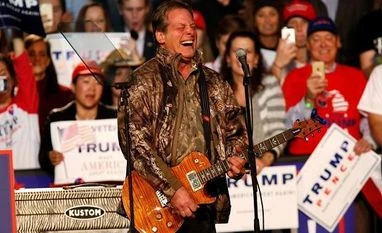
This White House has been, and is likely to remain, home to the first presidency in American history that is almost completely devoid of culture. In the 17 months that Donald Trump has been in office, he has hosted only a few artists of any kind. One was the gun fetishist Ted Nugent. Another was Kid Rock. They went together (and with Sarah Palin). Neither performed.
Since his inauguration in January 2017, there have been no official concerts at the White House (the Reagans had one every few weeks). No poetry readings (the Obamas regularly celebrated young poets). The Carters began a televised series, “In Performance at the White House,” which last aired in 2016, where artists as varied as Mikhail Baryshnikov and Patricia McBride performed in the East Room. The Clintons continued the series with Aretha Franklin and B B King, Alison Krauss and Linda Ronstadt.
But aside from occasional performances by “The President’s Own” United States Marine Band, the White House is now virtually free of music. Never have we had a president not just indifferent to the arts, but actively oppositional to artists. Trump disparaged the play Hamilton and a few weeks later attacked Meryl Streep. He has said he does not have time to read books (“I read passages, I read areas, I read chapters”). Outside of recommending books by his acolytes, Trump has tweeted about only one work of literature since the beginning of his presidency: Michael Wolff’s Fire and Fury. It was not an endorsement.
Every great civilisation has fostered great art, while authoritarian regimes customarily see artists as either nuisances, enemies of the state or tools for the creation of propaganda. The Soviet leader Nikita Khrushchev asserted that “the highest duty of the Soviet writer, artist and composer, of every creative worker” is to “fight for the triumph of the ideas of Marxism-Leninism.”
When John Kennedy took office, his policies reacted against both the Soviet Union’s approach to the arts and that of Joseph McCarthy, who had worked hard to create in the United States an atmosphere where artists were required to be allegiant and where dissent was called treason. Pivoting hard, Kennedy’s White House made support of the avant-garde a priority. The artists Franz Kline and Mark Rothko came to the inauguration, and at a state dinner for France’s minister of cultural affairs, André Malraux, the guests included Arthur Miller, Tennessee Williams, Robert Lowell, Geraldine Page and George Balanchine. Kennedy gave the Spanish cellist Pablo Casals, who had exiled himself to France and then Puerto Rico to protest Franco’s fascism, a forum in the East Room. Casals had performed in the White House once before, at the young age of 27. Now 84, and a man without a country, he played a mournful version of The Song of the Birds.
It’s crucial to note that the White House’s support of the arts has never been partisan. No matter their political differences, presidents and artists have been able to find common ground in the celebration of American art and in the artists’ respect for the office of the presidency. This mutual respect, even if measured, made for the occasional odd photo-op. George H W Bush met Michael Jackson, who wore faux-military garb, including two medals he seemed to have given himself. Richard Nixon heartily shook the hand of Elvis Presley, whose jacket hung over his shoulders like a cape.
George W Bush widened the partisan rift, but culturally, Bush — the future figurative painter — was open-minded and active. He met Bono in the Oval Office. He hosted a wide range of musicians, from Itzhak Perlman to Destiny’s Child. He was an avid reader — he maintained a long-running contest with Karl Rove to see who could read more books in a year. Laura Bush has long been a crucial figure in the book world, having co-founded the Texas Book Festival and the National Book Festival in Washington, now one of the country’s largest literary gatherings.
But perhaps no Republican could match the presidency of Ronald Reagan, whose guest list was a relentless celebration of the diversity of American culture. He and Nancy Reagan hosted Lionel Hampton. Then the Statler Brothers. Then Ella Fitzgerald. Then Benny Goodman. Then a night with Beverly Sills, Rudolf Serkin and Ida Levin. That was all in the fall of 1981.
©2018 The New York Times News Service

 "How Trump's White House has been almost completely stripped of its culture")











