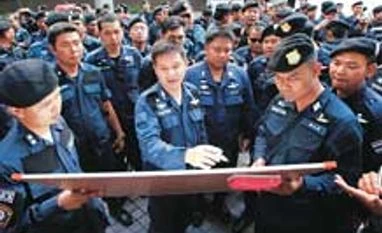
Thailand's military government sent thousands of troops and police into central Bangkok on Sunday and effectively stifled protests against its seizure of power on May 22, limiting them to small groups of demonstrators in and around shopping malls.
The military took over on May 22 after the government of Prime Minister Yingluck Shinawatra had been weakened by months of protests that had forced ministries to close for weeks on end, hurt business confidence and caused the economy to shrink.
The political turmoil pits the Bangkok-based royalist establishment dominated by the military, old-money families and the bureaucracy against supporters of former telecommunications mogul Thaksin Shinawatra, who is adored by the poor in the north and northeast.
Thaksin, who was ousted as premier in a 2006 coup, is the brother of Yingluck and was considered the real power behind her government. He has chosen to live in exile since fleeing a 2008 conviction for abuse of power.
Since the latest coup, the military has banned political gatherings of five or more people and protests that have taken place in Bangkok have been small and brief.
Deputy police chief Somyot Poompanmoung had told Reuters that 5,700 police and soldiers would be sent into central Bangkok on Sunday and rapid deployment units were ready to stop protests that might spring up elsewhere. Some top-end malls in the Ratchaprasong area chose to close or have reduced opening hours and the operator of the Skytrain overhead rail network shut several stations in the central area.
"It's a business centre and we need to protectively avoid any damage if authorities need to break up a gathering," Somyot said, adding mall owners could also find themselves in trouble with the authorities if protests took place on their premises.
In the morning, Ratchaprasong had been swarming with police and media but there was barely a protester to be seen.
The cavernous Central World mall opened four hours later than normal at 2 pm (0700 GMT). By mid-afternoon there were only a handful of shoppers in the mall, parts of which were burnt to the ground in the mayhem after an army crackdown on pro-Thaksin "red shirt" protesters in 2010.
"I feel safer now so, no, I didn't change my plans to come," said an expatriate American woman who has lived in Thailand for 30 years. "This country has been in turmoil for three years. It couldn't move forward under the previous government. I hope things can be resolved now."
A group of protesters gathered on an elevated walkway leading to the nearby Bangkok Art and Culture Centre, scene of small protests in the days after the military declared martial law on May 20 prior to its full takeover of government.
Hundreds of troops with riot gear arrived and suddenly stormed the walkway, sending protesters and onlookers fleeing.
Earlier, a group of about 30 people had protested inside Terminal 21 mall in the Asoke area. Most signalled their opposition to the coup by holding three middle fingers of one hand up in the air, which some said stood for freedom, equality and brotherhood.
Police detained one of the protesters. On Saturday, as on the two previous days, the authorities had effectively closed down the normally busy roads around Victory Monument, which was becoming a focal point for opposition to the coup. The area was flooded with police and troops but no protesters turned up.
'Reconciliation' In a televised address late on Friday, army chief and coup leader General Prayuth Chan-ocha said the military would need time to reconcile Thailand's antagonistic political forces and push through reforms. He outlined a process beginning with three months of "reconciliation".
A temporary constitution would be drawn up and an interim prime minister and cabinet chosen in a second phase, taking about a year, he said. An election would come at an unspecified time after that.
The United States, European Union countries and others have called for a rapid restoration of democracy through elections, the release of political detainees and an end to censorship.
Australia scaled back relations with the Thai military on Saturday and banned coup leaders from travelling there.
Sihasak Phuangketkeow, permanent secretary at Thailand's Foreign Ministry, played down foreign concerns and pleaded for understanding from his country's allies. "The fact is that Thailand is not going to disappear from the map," he told reporters on the sidelines of a regional security forum in Singapore on Sunday, noting his country's economic weight in Southeast Asia. "And importantly, we have already started a process of heading back on the democratic track," he said.
"As things progress, I do hope that our friends and partners will take these developments into consideration."

 "Huge Thai security force deployment stifles coup protests")


 Connect with us on WhatsApp