Home / World News / Nepal PM Sher Bahadur Deuba urges India to provide additional air routes
Nepal PM Sher Bahadur Deuba urges India to provide additional air routes
Nepalese PM Sher Bahadur Deuba has requested India to provide additional air routes from Mahendranagar, Nepalgunj and Janakpur to facilitate connectivity and travel between the two countries.
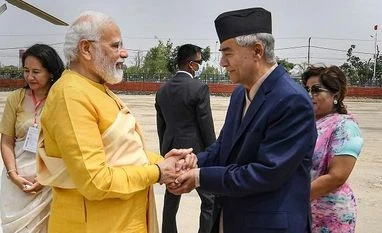
Prime Minister Narendra Modi being greeted by Nepal PM Sher Bahadur Deuba (PTI Photo)
2 min read Last Updated : May 17 2022 | 11:12 PM IST
Nepalese Prime Minister Sher Bahadur Deuba has requested India to provide additional air routes from Mahendranagar, Nepalgunj and Janakpur to facilitate connectivity and travel between the two countries.
Prime Minister Deuba made the request during a delegation-level talk with his Indian counterpart Narendra Modi on Monday in Lumbini - the birthplace of Gautam Buddha, according to sources at the Ministry of Foreign Affairs here.
He requested additional air routes in order to facilitate connectivity and travel between the two countries in view of the fact that the second international airport - Gautam Buddha International Airport - was brought into commercial operation in Bhairahawa starting from May 16, sources said.
Prime Minister Deuba also called for investment proposals from companies interested in India to develop the 750 MW West Seti Hydropower Project, they said.
The two leaders also agreed to move ahead with priority the Pancheshwar Project, said a press statement issued by the Foreign Ministry following the talks between the two prime ministers.
Prime Minister Deuba also proposed a long-term power trade agreement between the two countries for mutual interest as both sides expressed satisfaction over the progress in the 900 MW Arun-III hydropower project, it said.
During the meeting, both the leaders stressed the importance of hydropower for clean energy, with abundant possibilities for collaboration in the hydroelectricity sector between the two countries.
Prime Minister Modi said on Monday that he had an "excellent" meeting with Nepalese counterpart Deuba in Lumbini and discussed the full range of bilateral relations as the two sides inked key MoUs to diversify and deepen cooperation.
Prime Minister Modi visited the Himalayan nation at the invitation of his Nepalese counterpart Deuba on a day-long visit to Lumbini on the occasion of Buddha Purnima on Monday. It was his fifth visit to Nepal and first to Lumbini.
Land-locked Nepal relies heavily on India for the transportation of goods and services.
Nepal's access to the sea is through India, and it imports a predominant proportion of its requirements from and through India.
The India-Nepal Treaty of Peace and Friendship of 1950 forms the bedrock of the special relations between the two countries.
(Only the headline and picture of this report may have been reworked by the Business Standard staff; the rest of the content is auto-generated from a syndicated feed.)

 "Nepal PM Sher Bahadur Deuba urges India to provide additional air routes")

