Nobel Prize in medicine for discovery of temperature, touch receptors

The Nobel Prize in the field of physiology or medicine has been awarded to US scientists David Julius and Ardem Patapoutian.
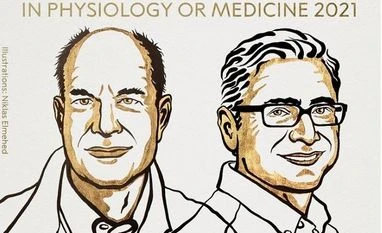
Noble Prize medicine
APPTI Stockholm
2 min read Last Updated : Oct 05 2021 | 2:22 AM IST
Two US-based scientists were awarded the Nobel Prize in physiology or medicine on Monday for their discovery of the receptors that allow humans to feel temperature and touch.

David Julius and Ardem Patapoutian focused their work on the field of somatosensation, that is the ability of specialized organs such as eyes, ears and skin to see, hear and feel.

This really unlocks one of the secrets of nature, said Thomas Perlmann, secretary-general of the Nobel Committee, in announcing the winners. It's actually something that is crucial for our survival, so it's a very important and profound discovery.

The committee said Julius, 65, used capsaicin, the active component in chili peppers, to identify the nerve sensors that allow the skin to respond to heat.

Patapoutian found separate pressure-sensitive sensors in cells that respond to mechanical stimulation, it said.

The pair shared the prestigious Kavli Award for Neuroscience last year.

Imagine that you're walking barefoot across a field on this summer's morning, said Patrik Ernfors of the Nobel Committee. You can feel the warmth of the sun, the coolness of the morning dew, a caressing summer breeze and the fine texture of blades of grass underneath your feet. These impressions of temperature, touch and movement are feelings relying on somatosensation."

Such information continuously flows from the skin and other deep tissues and connects us with the external and internal world. It is also essential for tasks that we perform effortlessly and without much thought, said Ernfors.

Perlmann said he managed to get hold of both of the winners before the announcement.

I (...) only had a few minutes to talk to them, but they were incredibly happy, he said. And as far as I could tell they were very surprised and a little bit shocked, maybe.

Last year's prize went to three scientists who discovered the liver-ravaging hepatitis C virus, a breakthrough that led to cures for the deadly disease and tests to keep the scourge from spreading though blood banks.

The prestigious award comes with a gold medal and 10 million Swedish kronor (over $1.14 million). The prize money comes from a bequest left by the prize's creator, Swedish inventor Alfred Nobel, who died in 1895.

The prize is the first to be awarded this year. The other prizes are for outstanding work in the fields of physics, chemistry, literature, peace and economics.

One subscription. Two world-class reads.

Already subscribed? Log in

Subscribe to read the full story →
*Subscribe to Business Standard digital and get complimentary access to The New York Times

Smart Quarterly

₹900

3 Months

₹300/Month

SAVE 25%

Smart Essential

₹2,700

1 Year

₹225/Month

SAVE 46%
*Complimentary New York Times access for the 2nd year will be given after 12 months

Super Saver

₹3,900

2 Years

₹162/Month

Subscribe

Renews automatically, cancel anytime

Here’s what’s included in our digital subscription plans

Exclusive premium stories online

  • Over 30 premium stories daily, handpicked by our editors

Complimentary Access to The New York Times

  • News, Games, Cooking, Audio, Wirecutter & The Athletic

Business Standard Epaper

  • Digital replica of our daily newspaper — with options to read, save, and share

Curated Newsletters

  • Insights on markets, finance, politics, tech, and more delivered to your inbox

Market Analysis & Investment Insights

  • In-depth market analysis & insights with access to The Smart Investor

Archives

  • Repository of articles and publications dating back to 1997

Ad-free Reading

  • Uninterrupted reading experience with no advertisements

Seamless Access Across All Devices

  • Access Business Standard across devices — mobile, tablet, or PC, via web or app

Topics :Nobel PrizeMedicines

Next Story



