
Oil up as Trump decides on climate pact, yuan shrugs off weak factory data
Even as May factory activity grew quickest in over 6 yrs, bank shares nullified rising Euro stocks
 "Oil up as Trump decides on climate pact, yuan shrugs off weak factory data")
WebinarsNew
Deep DiveNew
Explore Business Standard
Even as May factory activity grew quickest in over 6 yrs, bank shares nullified rising Euro stocks
Oil prices rose on Thursday, lifting energy company shares, on expectations the United States (US) will withdraw from a global pact to fight climate change, while China's yuan shrugged off weak factory data to hit a seven-month high against the dollar.
Bank shares underperformed rising European stocks, after two major US lenders warned on Wednesday that low market volatility would crimp trading revenue.
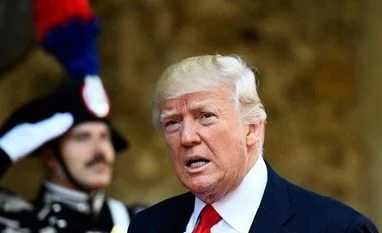
Brent crude, the international benchmark for the oil market, rose off Wednesday's three-week lows in anticipation of the US quitting the Paris accord. President Donald Trump is expected to announce his decision later on Thursday.
"If he actually withdraws the US from the climate accord, this would signal his intention to further roll-back emission regulations that would favour the use and demand of fossil fuels, thus giving a much needed boost to oil prices," said Jonathan Chan, investment analyst at Phillip Futures in Singapore.
A fall in US crude inventories also supported prices. Brent last traded at $51.39 a barrel, up 64 cents, having touched a low of $50.31 on Wednesday.
The wider STOXX 600 index rose 0.5 per cent, led higher by industrials.
European manufacturing activity grew at its fastest rate in more than six years in May, according to a euro zone purchasing managers' index.
European bank stocks were flat. Financial sector shares fell on Wall Street on Wednesday after JPMorgan blamed lower volatility for a 15 per cent fall in trading revenue and Bank of America said second-quarter trading revenue was on track to be 10-12 per cent down on last year.
The CBOE VIX index of implied volatility on the S&P 500 ended Wednesday at 10.41, its lowest end-month close.
Despite a stumble in recent days, especially banks and miners have led global stocks steadily higher since Trump's election in November, limiting the market swings from which traders profit.
Asian shares, as measured by MSCI's main index of Asia-Pacific shares, excluding Japan rose 0.1 per cent, though gains were limited by data showing Chinese factory activity contracted in May for the first time in 11 months.
Chinese Shanghai Composite share index fell 0.5 per cent after the a private survey of the manufacturing sector. The findings contrasted with official data on Wednesday which suggested growth remained steady.
China's yuan, however, strengthened beyond 6.8 per dollar for the first time since November 11 after the central bank pushed its reference rate, around which the spot rate can fluctuate, 0.8 per cent higher in the second-largest single-day appreciation of the currency since it was de-pegged from the dollar in 2005.
Traders said major state-owned banks were selling dollars.
"The PBOC has let the yuan bulls loose in the China shop," said Stephen Innes, senior trader at OANDA in Australia, referring to the People's Bank of China.
Spot yuan last stood at 6.7996 per dollar, having strengthened as far as 6.7878 earlier. As recently as May 24, it traded at 6.8949 per dollar.
The Chinese data also hit the Australian dollar, often seen as a proxy for the health of the world's second-biggest economy. Australia's currency fell 0.2 per cent at $0.7416, having earlier fallen to $40.7384, its weakest since May 12.
Britain's pound, on a rollercoaster ride this week as polls have sent conflicting signals about the outcome of next week's election, fell 0.1 per cent to $1.2874 after another poll showed the Prime Minister Theresa May's Conservatives just 3 percentage points ahead of the Labour opposition.
There was little reaction to Britain's manufacturing PMI beating forecasts.
"This data point is clearly a positive for the UK economy, however, GBP traders are putting macro releases on the back burner at present, with the twists and turns in the race for upcoming election having a greater impact on the market of late," David Cheetham, markets analyst at broker XTB, said.
The dollar index, which measures the US currency against a basket of its peers, rose 0.2 per cent.
The euro eased 0.1 per cent to $1.1228 while the Japanese yen fell 0.3 per cent to 111.11 per dollar.
First Published: Jun 01 2017 | 4:32 PM IST

