Oman's Sultan Qaboos dies; ruling family called upon to choose successor

Sultan Qaboos bin Said had no children and had not publicly appointed a successor.
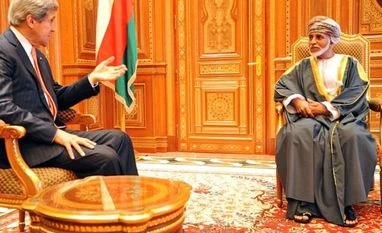
Oman, Sultan Qaboos,
Oman's late Sultan Qaboos bin Said al Said
Lisa Barrington and Nayera Abdallah | Reuters Dubai/Cairo
2 min read Last Updated : Jan 11 2020 | 9:23 PM IST

Don't want to miss the best from Business Standard?

Oman's ailing Sultan Qaboos bin Said, one of the Middle East's longest serving rulers, died on Friday and the Gulf state's high military council called on the ruling family to convene to choose a successor, state media said.

Three days of official mourning have been declared, with flags flown at half-mast for 40 days for the Western-backed Qaboos, 79, who had ruled since taking over in a bloodless coup in 1970 with the help of former colonial power Britain.

State news agency ONA did not give a cause of death, but Qaboos had been unwell for years and spent a week in Belgium undergoing medical treatment in early December.

Qaboos had no children and had not publicly appointed a successor. A 1996 statute says the ruling family will choose a successor within three days of the throne becoming vacant.

The high military council, in a statement carried on state media on Saturday, called on Oman's ruling family council to convene to choose a new ruler.

If the council fails to agree, a council of military and security officials, supreme court chiefs and heads of the two consultative assemblies will put in power the person whose name has been secretly written by the sultan in a sealed letter.

There has been wide speculation over the succession as domestic challenges loom large, from strained state finances to high unemployment.

Oman observers say the sultan's three cousins - Assad, Shihab and Haitham bin Tariq al-Said - stand the best chance.

"I imagine that the succession itself will be a smooth process within Oman," Kristian Coates Ulrichsen of the Texas-based Rice University's Baker Institute told Reuters.

The sultan's death comes at a time of heightened tension in the region between Iran and the United States and U.S. ally Saudi Arabia.

Oman maintains friendly ties with Washington and Tehran and helped mediate secret U.S.-Iran talks in 2013 that led two years later to the international nuclear pact which Washington quit in 2018.

"Sultan Qaboos had such charismatic authority and became so synonymous with Oman as a modern nation-state that it will naturally be difficult for any successor to replicate that, at least at the beginning," Ulrichsen said.

One subscription. Two world-class reads.

Already subscribed? Log in

Subscribe to read the full story →
*Subscribe to Business Standard digital and get complimentary access to The New York Times

Smart Quarterly

₹900

3 Months

₹300/Month

SAVE 25%

Smart Essential

₹2,700

1 Year

₹225/Month

SAVE 46%
*Complimentary New York Times access for the 2nd year will be given after 12 months

Super Saver

₹3,900

2 Years

₹162/Month

Subscribe

Renews automatically, cancel anytime

Here’s what’s included in our digital subscription plans

Exclusive premium stories online

  • Over 30 premium stories daily, handpicked by our editors

Complimentary Access to The New York Times

  • News, Games, Cooking, Audio, Wirecutter & The Athletic

Business Standard Epaper

  • Digital replica of our daily newspaper — with options to read, save, and share

Curated Newsletters

  • Insights on markets, finance, politics, tech, and more delivered to your inbox

Market Analysis & Investment Insights

  • In-depth market analysis & insights with access to The Smart Investor

Archives

  • Repository of articles and publications dating back to 1997

Ad-free Reading

  • Uninterrupted reading experience with no advertisements

Seamless Access Across All Devices

  • Access Business Standard across devices — mobile, tablet, or PC, via web or app

Topics :Oman

Next Story



