The hubbub that descends each summer on a sleek exhibition hall in Basel, where collectors snap up art and hunt for hot-ticket new talent, is likely to be replaced this year by lines of socially distanced Swiss waiting for Covid-19 vaccines.
The Herzog & de Meuron building usually hosts one of the world’s biggest art fairs in June, but last year’s event was cancelled due to the pandemic and this year’s has been moved to September. The adjoining congress centre, meanwhile, has been turned into a vaccination hub.
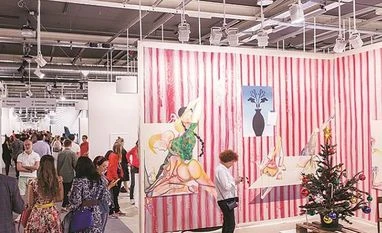
The art world is reeling from the impact of lockdowns, travel bans and social distancing, and fairs like Art Basel suffered more than most. The business of buying and selling art is having to adapt to limit the damage.
Global art sales fell 22 per cent in 2020 to $50.1 billion, UBS and Art Basel’s Art Market Report published on Tuesday showed, the steepest market drop since the financial crisis. But the picture was uneven, as buying by the ultra-wealthy, notably from Asia, held up.
In contrast to the 2007-2009 financial crisis, when many of the world’s rich lost money, the super-rich have become richer during the pandemic as financial stimulus and volatile markets served to increase their fortunes. Big auctions houses, led by Sotheby’s and Christie’s, were already used to telephone bidding and online sales, and so could pivot relatively easily to appeal to cash-rich clients.
Both reported an overall dip but saw record online activity and resilience among Asian buyers, while pre-pandemic trends of interest in Black, female and living artists were reinforced. This year, they hope to build on that, capitalising on an influx of young collectors who have found the online world more accessible than old-style auction rooms, and as more traditional buyers yearn to return to the real world.
“There is enormous pent-up demand for experiences and even spending, once there’s a bit more stability and predictability,” Sotheby’s Chief Executive Charles Stewart told Reuters. “We have the potential for just the biggest boom for a period of time, assuming that we get to a place where people are comfortable leaving their house.”
For Christie’s, 2021 has seen spectacular confirmation of the potential to create wealth from the virtual world as it hosted a record-breaking $70 million digital artwork sale this month. In an online auction held over 14 days, bids on the work by US artist Beeple started at $100 and accelerated dramatically, with 22 million visitors tuning in for the final minutes of bidding. Christie’s plans to follow up on the success with further sales of non-fungible tokens, or artworks that exist only in digital form. More people appear to be willing to purchase artworks online without seeing the real thing first.
“What we have observed is the simple behavioural truth that collectors are more willing than ever before to buy from an image,” said Rachel Lehmann, co-founder of New York gallery Lehmann Maupin.
For German artist ANTOINETTE, lockdown was not all bad: the cancellation of public events allowed her an extended stay in the east German castle of Merseburg where she was working. Using only pencils, she is creating intricate drawings on 5-metre high panels that form part of a multi-year project on European cultural identity entitled “ALTAR of Europe”.
“I’ve come to feel like a part of the community,” the artist told Reuters.
Smaller galleries are also struggling, experts say, because the pandemic has accelerated the concentration of the art world into fewer hands - very wealthy buyers and high-profile and established sellers. “Compared to the last recession, when everybody’s wealth went down, in this one billionaire wealth has really risen,” art economist Clare McAndrew, who authored the Art Market report, said. The UBS and Art Basel report found fairs accounted for 43 per cent of art dealer sales in 2019 but only 22 per cent in 2020, just under half of which were generated by digital events.
“The digital world is concentrating buying on what is fashionable (on social media) and through the big galleries that employ over 100 people,” said James Mayor, who has run the Mayor Gallery in London since taking it over from his father in 1973. During a normal year, Art Basel’s nearly 100,000 visitors to the city help boost hotel room occupancy to almost full capacity during the first four days of the fair, or by some 35 per cent–60 per cent over average levels over the week, Basel’s tourism office said.
Galleries and advisers interviewed by Reuters anticipated a recovery in demand for fairs and art tourism post-pandemic.
Art Basel has scheduled a fair in Hong Kong for late May. Other major fairs, including TEFAF and Frieze, have said they expect to proceed with live fairs in some format later this year, complemented by digital participation. But even before the Covid-19 crisis, some said there were too many fairs, and galleries and collectors say they will be more selective, sticking to the more local focus they have experienced over the last year.

 "One year into coronavirus pandemic, the art world adapts to survive")











