In recent years, a number of big companies — IBM, Bank of America, Aetna, Yahoo! under former chief executive officer Marissa Mayer — cut back on their telecommuting programs in the name of more interaction and cooperation between employees, supposedly fostered by being stuck together in an office. The business model of companies providing co-working spaces, such as $20 billion “unicorn” WeWork, is also based on the proposition that if people find themselves in a shared space, they’ll network and cooperate more.
It doesn’t quite work like that, though, recent research shows. At the office, be it a corporate one or a WeWork-style environment, workers these days are housed in vast open spaces designed to break down barriers. But in a just-published paper, Harvard University’s Ethan Bernstein and Stephen Turban showed, on the basis of two field studies of corporate headquarters, that the modern open office architecture tends to decrease the volume of face-to-face interaction by some 70 per cent and increases electronic communication accordingly. With such a communication pattern, the workers might as well be anywhere.
The two companies Bernstein and Turban studied, both Fortune 500 multinationals, were transitioning to more open, modern office environments. One of them removed all the walls on one of its office floors. The researchers fitted workers from functions as varied as sales, technology, finance and human resources with high-tech tracking devices, so-called sociometric badges, for 15 days before and 15 days after they moved from walled offices to the new architecture. In the “walled” period, the employees spent an average of 5.8 hours a day interacting face to face; in the open space, that shrank to 1.7 hours. At the same time, they ended up sending 56 per cent more emails and 67 per cent more instant messages, which became 75 per cent longer, too.
The second company was moving from cubicles to an open space design for its entire international headquarters. The 100 employees fitted with sociometric badges traded their seats, located some two metres (6.6 feet) apart but separated by cubicle walls, for workplaces located just as densely but without any barriers, in groups of six to eight desks. This decreased face-to-face interactions by 67 per cent and increased e-mail traffic. Counterintuitively, the physical distance between the communicating employees had no significant effect on how they interacted. Physical proximity, it seems, is overrated as a cooperation enhancer.
Open offices, Bernstein and Turban wrote, tend to be “overstimulating.” Too much information, too many distractions, too many people walking around or even just staring at their monitors —all that “appears to have the perverse outcome of reducing rather than increasing productive interaction.”
The authors don’t psychoanalyse their results. One possible explanation is that placing people in an enormous fish tank in which they have no personal space makes people cringe rather than make them more gregarious.
There could be other explanations: For example, it’s easy to see in an open space that someone is busy, so people may be reluctant to interrupt a colleague in the middle of a pressing task.
But no matter what’s going on psychologically, the changes in the communications mix can hurt the business. Bernstein and Turban noted that the first company’s executives reported to them “that productivity, as defined by the metrics used by their internal performance management system, had declined after the redesign to eliminate spatial boundaries.” That, they noted, was consistent with research that shows that declines in media richness — that in, in the involvement of all our senses in communication — adversely affect productivity.

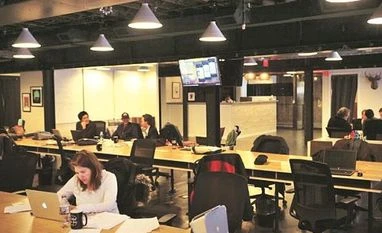 "Open-plan offices are making us less social")












 Connect with us on WhatsApp