The Palestinians raised their flag at the United Nations today for the first time as president Mahmud Abbas called on the world body to grant them full membership.
UN Secretary-General Ban Ki-moon and Abbas presided over the packed ceremony in the rose garden after the Palestinian leader launched a searing attack at the General Assembly on Israel's continued occupation.
"In this historical moment, I say to my people everywhere: raise the flag of Palestinians very high because it is the symbol of our identity," the 80-year-old Abbas told the crowd. "It is a proud day."
Israel and the United States have dismissed the move as a symbolic gesture that would not serve the cause of peace. But Ban said symbols were "important" and could lead to action.
"Now is the time to restore confidence by both Israelis and Palestinians for a peaceful settlement and, at last, the realization of two states for two peoples," he said.
The red, black, white and green Palestinian flag was then hoisted under dark clouds that threatened rain. The crowd broke out into cheers when it started to flutter in the gentle breeze.
Dozens of people gathered in the West Bank town of Ramallah to watch the flag-raising by TV link. When the small crowd saw Abbas on the screen, they stood cheering and then fell silent to hear him.
The General Assembly voted September 10 to allow the flags of Palestine and the Vatican -- both have observer status -- to be raised at the world body alongside those of member states.
The resolution was backed by 119 countries, with 45 abstentions and eight votes against, including Australia, Israel and the United States.
Abbas used his speech today at the General Assembly to appeal for "those countries that have not yet recognized the state of Palestine yet, to do so."
"Palestine, which is an observer state in the United Nations, deserves full recognition and full membership," he said.
Clashes in recent weeks between Israeli police and Palestinians at the sensitive Al-Aqsa mosque compound in Jerusalem have raised tensions and prompted Abbas to warn of the risk of a third intifada, or uprising.
"I call on the Israeli government to cease its use of brutal force... Particularly its actions at the Al-Aqsa mosque," Abbas told the Assembly.
"Such actions will convert the conflict from a political one to a religious one, thus creating a explosive situation in Jerusalem and the remaining Palestinian occupied territory."
A recent poll found that Palestinians are increasingly exasperated with his leadership and Israel's right-wing government.
A majority favor a return to armed uprising in the absence of peace talks and two-thirds want Abbas to resign.

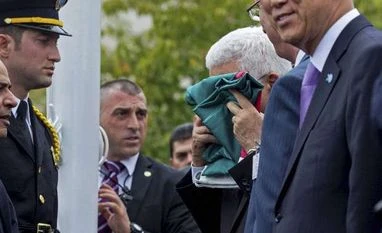 "Palestinian flag flies at UN for first time")


 Connect with us on WhatsApp