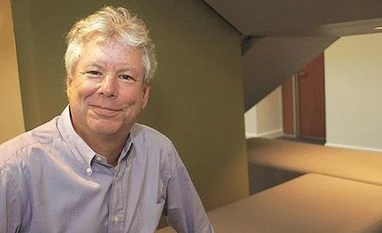
Richard H Thaler was awarded the Nobel Memorial Prize in Economic Science on Monday for his contributions to behavioural economics.
Thaler, born in 1945 in East Orange, New Jersey, works at the University of Chicago’s Booth School of Business. The Nobel committee, announcing the award in Stockholm, said that he was a pioneer in applying psychology to economic behaviour and in shedding light on how people make economic decisions, sometimes rejecting rationality.
His research, the committee said, had taken the field of behavioural economics from the fringe to the mainstream of academic research and had shown that it had important implications for economic policy.
He also found that people care deeply about fairness. For example, an umbrella store might not raise prices during a rainstorm — or at least might not raise prices as high as it could — because it was aware that people may choose to get wet rather than reward a shop that they considered to be price gouging.
The Nobel committee described how Thaler’s theory of “mental accounting” explained how people simplify financial decisions by focusing on the narrow impact of each decision rather than on its overall effect. He also showed how aversion to losses can explain why people value the same item more highly when they own it than when they do not, a phenomenon called the endowment effect.
Thaler’s theories also shed light on why New Year’s resolutions can be hard to keep and on the tension between long-term planning and short-term doing.
Succumbing to short-term temptation is an important reason many people fail in their plans to save for old age, or to make healthier lifestyle choices, according to Thaler’s research. He also demonstrated how seemly small changes in how systems work, or “nudging” — a term he invented — could help people exercise better self-control when, for example, saving for a pension.
Thaler had a cameo appearance, alongside the actress and singer Selena Gomez, in the film The Big Short, in which he used behavioural economics to help explain the causes of the financial crisis. Asked about his “short Hollywood career,” he joked that he was disappointed his acting prowess had not been mentioned during the summary of his achievements when the award was announced.
Why was the work important?
Thaler’s work has forced economists to grapple with the limits of traditional analysis based on the assumption that people are rational actors.
He has also been unusually successful in directly influencing public policy.
One of his most important contributions is his influence on the shift to retirement plans that automatically enroll employees, and to policies that offer employees the option of increasing their contributions over time. Both reflect Thaler’s insight that inertia can be used to shape beneficial outcomes without limiting human choice.
In a 2008 book, Nudge, written with Cass R Sunstein, Thaler argued governments had many opportunities to improve the design of public policy.
Two years later, the British government created a behavioural economics unit based on Thaler’s advice that pursued such opportunities. Other countries, including the United States, have followed suit. Some victories are relatively minor, such as sending to people who have not paid auto registration fees a letter with a picture of the car, which has been found to increase the rate of payment. Others are more profound, like automatically enrolling eligible children in school meal programmes.
© 2017 The New York Times News Service

 "Psychology of economics: Richard Thaler bags Nobel")












