
Syria chemical attack: Everything you need to know
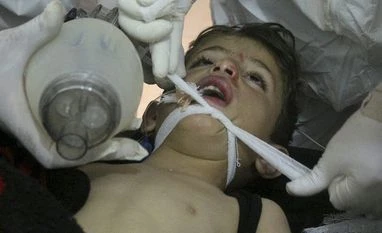
The attack on led to at least 70 deaths and more than 100 people requiring medical attention
 "Syria chemical attack: Everything you need to know")
premium
WebinarsNew
Deep DiveNew
Explore Business Standard
The attack on led to at least 70 deaths and more than 100 people requiring medical attention
The April 4, 2017 chemical attack on the rebel-held town of Khan Sheikhoun in Syria led to at least 70 deaths and more than 100 people requiring medical attention, prompting an outcry from the international community. It led to the April 7 US bombing of the Shayrat air base.
It is alleged that sarin was used in the Khan Sheikhoun attack. This particular chemical became famous in 1995 with the Tokyo subway attack, launched by members of the cult movement Aum Shinrikyo.
Was it sarin?
Sarin is an organophosphorus compound and was first synthesised in 1938 in Germany as part of a pesticide research program.
Sarin is a moderately volatile substance – that is, it readily forms a gas – which can be taken up by inhalation or skin contact. It is an inhibitor of the enzyme acetylcholinesterase, which is critical in regulating nerve function.
When exposed to a low dose of a nerve agent such as sarin, people experience increased production of saliva, a running nose and a feeling of pressure on the chest. The pupils of the eye becomes contracted, so-called “pin-point” pupils.
Pin point pupils, which have been recorded in video footage of the Khan Sheikhoun attack, are a characteristic consequence of acetylcholinesterase inhibitors like sarin. This clinical sign is quite different from the irritating effects of chlorine and mustard gas.
Medium to higher dose exposure to sarin and other nerve agents can result in difficulty in breathing and coughing, abdominal cramps and vomiting, and sometimes involuntary discharge of urine and faeces. Increased saliva production, running eyes and sweating may occur, as well as muscular weakness, tremors or convulsions. Loss of consciousness, and death due to respiratory failure may be seen at higher doses.
Survivors of the Tokyo subway sarin attack recovered reasonably well but experienced some clinically detectable neurological effects, and some evidence of brain changes.
Although sarin use is suspected in Khan Sheikhoun, there are many organophosphorus insecticides that would exert the same effect (in sufficient quantity). It is possible that an organophosphate pesticide or a simple organophosphate (not normally classified as a chemical weapon) was used in this attack.
The production of sarin requires special facilities and is expensive, perhaps running into the tens of millions of dollars. Similar chemicals, such as tabun, are less expensive to make.
Will we ever know what was used?
In order to establish the identity of the substances used in Khan Sheikhoun, a combination of information needs to be gathered and assessed. In particular the results of chemical tests on wipe samples, soil and clothing samples must be determined and verified.
The Organisation for the Prohibition of Chemical Weapons (OPCW) Fact Finding Team would be the most authoritative source to reveal the nature of the chemical(s) used, and we will await their report. However, in the past these reports have been inconclusive owing to the time taken to gather chemical samples, limits of detection, specificity and the presence of mixtures.
The conflict in Syria involves the government military forces, the rebels, ISIS and the Kurds. It is sometimes hard to know where the chemicals might be coming from (for example, from neighbouring countries), or whether they have been produced or sourced locally.
Local history of chemical attacks
This experience in Syria may lead to improved medical responses in the case of future attacks. But in the absence of detailed knowledge of the substances involved, the treatment of casualties is unlikely to be optimal.
With so many individual chemical substances, and improvised mixtures, only generic decontamination and treatment procedures can be used. However, it may be feasible to have chemical specialists attached to hospitals collecting and storing specimens for subsequent analysis.
Sadly, the use of chemicals in Khan Sheikhoun is not an isolated incident. After all, a recent report of the OPCW Fact Finding Mission for the period December 2015 to November 20, 2016, recorded 65 potential incidents of the use of chemical weapons reported in open sources.
The use of chemical weapons has a long history in the region. On March 16, 1988, Iraq dropped bombs containing multiple toxic chemicals on the Kurdish city of Halabja, killing thousands.
Dino Pisaniello, Professor of Public Health , University of Adelaide
This article was originally published on The Conversation. Read the original article.
Already subscribed? Log in
Subscribe to read the full story →

3 Months
₹300/Month
1 Year
₹225/Month
2 Years
₹162/Month
Renews automatically, cancel anytime

Premium stories handpicked daily by our editors


News, Games, Cooking, Audio, Wirecutter & The Athletic
Digital replica of our daily newspaper — with options to read, save, and share


Insights on markets, finance, politics, tech, and more delivered to your inbox
In-depth market analysis & insights with access to The Smart Investor


Repository of articles and publications dating back to 1997
Uninterrupted reading experience with no advertisements


Access Business Standard across devices — mobile, tablet, or PC, via web or app
First Published: Apr 12 2017 | 9:37 AM IST


 Connect with us on WhatsApp