The world's 20 top economies in 2030
A peek at the new world that awaits us
BloombergGet ready for a new economic order. In the world 15 years from now, the US will be far less dominant, several emerging markets will catapult into prominence, and some of the largest European economies will be slipping behind.
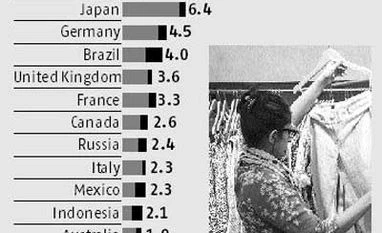
That's according to the US Department of Agriculture's latest macroeconomic projections that go out to 2030, displayed in the chart below. The US will just barely remain the global leader, with $24.8 trillion in annual output. The grey bar represents the $16.8 trillion gross domestic product projected for 2015, and the black bar shows how much bigger the economy is expected to be 15 years from now. The country, worth 25 per cent of the world economy in 2006 and 23 per cent in 2015, will see its share decline to 20 per cent.
China's GDP will grow to more than twice its size today, helping the Asian powerhouse to almost entirely close its gap with the US.
India, ranked eighth for 2015, will climb past Brazil, the United Kingdom, France, Germany and Japan to take third place in the world ranking. The International Monetary Fund calls India "the bright spot in the global landscape." The country will have the largest workforce in the world within the next 15 years, the IMF notes, and among the youngest.
Other nations won't be so lucky, particularly among developed economies. Japan, which was a roaring economy until its asset bubble burst in the early 1990s, has already slogged through decades of stagnation and will likely continue to see very little growth over the next 15 years. That will push Japan down a spot in the rankings by 2030, according to the USDA estimates.
Japan is "an important lesson in how quickly you can downshift your status of what a structure of an economy delivers," said Bruce Kasman, JPMorgan's chief economist.
France will slide three spots, while Italy drops two.
In the overall ranking, Jamaica will surrender the most ground, bumping down 13 places to 136. Countries with the biggest advances - like Uganda, which will climb 18 spots to rank 91 - are concentrated in Africa, Asia and West Asia.
It's important to take estimates stretching out so far with a note of caution, though.
"There are lots of uncertainties," said Kasman. "Whether China grows at 4 per cent or 6 per cent matters an awful lot for where it looks like it's going to be in the global economy. Whether India grows at 3 per cent or 8 per cent - these are huge differences when you compound them over long periods of time."
The USDA is not the only - and hardly the most widely-followed - ranking of global economic growth, though it does offer the advantage of particularly long-term outlooks. The International Monetary Fund's economic outlook only projects out two years. Look out for it later this month.
And if 15 years is too far out for you, take a look at the fastest-growing economies just for this year.

 "The world's 20 top economies in 2030")


 Connect with us on WhatsApp