
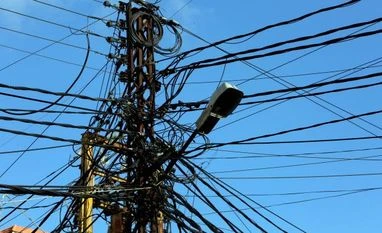
Total power outage in Lebanon as grid shuts down after running out of fuel
Lebanon's electricity grid has shut down entirely after the country's two main power stations ran out of fuel
 "Total power outage in Lebanon as grid shuts down after running out of fuel")
Explore Business Standard
Lebanon's electricity grid has shut down entirely after the country's two main power stations ran out of fuel
Lebanon which is already grappling with Already skyrocketing inflation and shortage of essential items is now facing an acute power crisis due to fuel shortage.
Lebanon's electricity grid has shut down entirely after the country's two main power stations ran out of fuel, Sky News reported citing media reports.
The al Zahrani and the Deir Ammar power stations stopped working after supplies of diesel were apparently exhausted, and energy production dropped to below 200 megawatts, said Sky News report.
"The Lebanese power network completely stopped working at noon today, and it is unlikely that it will work until next Monday, or for several days," an official told Sky News.
According to Al Jazeera, Lebanon's continuing economic crisis has created a fuel shortage, adding extended power cuts to the miseries of its people.
While experts have said a proposal recently put forth by the US ambassador in Lebanon to revive a transnational gas pipeline running from Egypt to Lebanon could help alleviate the problem, it is far from a long-term solution for the country's continuing failure to generate sufficient electricity.
"It's not a new idea. From 2009 to 2010, gas was being pumped through Egypt to Jordan and through Syria to Lebanon," Diana Kaissy, a board member of the Lebanese Oil and Gas Initiative and an expert on energy governance, told Al Jazeera.
That arrangement, using the Arab Gas Pipeline, ended when Lebanon defaulted on payments and attacks on the pipeline in Egypt disrupted supplies. Studies are also still needed to address what damage Syria's war may have done to the pipeline.
"Technically speaking, it could be done by the end of this year if there is serious political will," Kaissy said.
Meanwhile, Energy ministers from Egypt, Lebanon, Syria and Jordan met in Amman on Wednesday where they affirmed their willingness to facilitate transfers of gas to energy-strapped Lebanon.
Lebanese officials have said the World Bank has offered to provide funding for the gas but provided no other details.
Lebanon in the past two years has been offered a number of international loans and grants, including from the IMF, on the condition that the country implement reforms with regards to transparency and corruption -- something its governing class has not yet done, even as the country sinks deeper into poverty and dysfunction.
A World Bank spokeswoman told Al Jazeera on Tuesday that the Bank was unable at this time to give details of what may have been discussed.
(Only the headline and picture of this report may have been reworked by the Business Standard staff; the rest of the content is auto-generated from a syndicated feed.)
First Published: Oct 09 2021 | 7:04 PM IST


