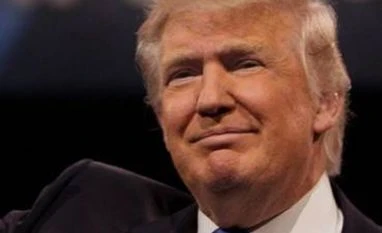
Donald J Trump, the Republican presidential front-runner, said that if elected, he might halt purchases of oil from Saudi Arabia and other Arab allies unless they commit ground troops to the fight against the Islamic State or "substantially reimburse" the United States for combating the militant group, which threatens their stability.
"If Saudi Arabia was without the cloak of American protection," Trump said during a 100-minute interview on foreign policy, spread over two phone calls on Friday, "I don't think it would be around."
He also said he would be open to allowing Japan and South Korea to build their own nuclear arsenals rather than depend on the American nuclear umbrella for their protection against North Korea and China. If the United States "keeps on its path, its current path of weakness, they're going to want to have that anyway, with or without me discussing it," Trump said.
And he said he would be willing to withdraw US forces from Japan and South Korea if they did not substantially increase their contributions to the costs of housing and feeding those troops. "Not happily, but the answer is yes," he said.
In Trump's worldview, the US has become a diluted power, and the main mechanism by which he would re-establish its central role in the world is economic bargaining. He approached almost every current international conflict through the prism of a negotiation, even when he was imprecise about the strategic goals he sought. He again faulted the Obama administration's handling of the negotiations with Iran last year - "It would have been so much better if they had walked away a few times," he said - but offered only one new idea about how he would change its content: Ban Iran's trade with North Korea.
He argued that the best way to halt China's placement of military airfields and antiaircraft batteries on reclaimed islands in the South China Sea was to threaten its access to American markets. "We have tremendous economic power over China. And that's the power of trade." He did not mention Beijing's ability for economic retaliation.
He agreed with a suggestion that his ideas might be summed up as "America First." "Not isolationist, but I am America first. I like the expression." He said he was willing to reconsider traditional American alliances if partners were not willing to pay, in cash or troop commitments, for the presence of American forces around the world. "We will not be ripped off anymore."
In the past week, the bombings in Brussels and an accelerated war against the Islamic State have shifted the focus of the campaign trail conversation back to questions of how the candidates would defend the US and what kind of diplomacy they would pursue. Trump explained his thoughts in concrete and easily digestible terms, but they appeared to reflect little consideration for potential consequences. He personalised how he would engage foreign nations, suggesting his approach would depend partly on "how friendly they've been toward us," not just on national interests or alliances.
Like Richard M Nixon, Trump emphasised the importance of "unpredictability" for an American President, arguing that the country's traditions of democracy and openness had made its actions too easy for adversaries and allies alike to foresee. "I wouldn't want them to know what my real thinking is," he said of how far he was willing to take the confrontation over the islands in the South China Sea, which are remote and lightly inhabited but extend China's control over a major maritime thoroughfare. But, he added, "I would use trade, absolutely, as a bargaining chip."
Asked when he thought American power had been at its peak, Trump reached back 116 years to the turn of the 20th century, the era of another unconventional Republican, Theodore Roosevelt, who ended up leaving the party. His favourite figures in American history, he said, include two generals, Douglas MacArthur and George S Patton - though he said that, unlike MacArthur, he would not advocate using nuclear weapons except as a last resort. (He suggested MacArthur had pressed during the Korean War to use them against China as a means "to negotiate," adding, "He played the nuclear card, but he didn't use it.")
Pressed about his call to "take the oil" controlled by the Islamic State in the West Asia, Trump acknowledged that this would require deploying ground troops, something he does not favour. "We should've taken it, and we would've had it," he said, referring to the years in which the US occupied Iraq. "Now we have to destroy the oil."
He did not rule out spying on American allies, including leaders like Angela Merkel, the German chancellor, whose cellphone was apparently a target of the National Security Agency. Obama said the agency would no longer target her phone but made no such commitments about the rest of Germany, or Europe. "I'm not sure that I would want to be talking about that," Trump said. "You understand what I mean by that." Trump was not impressed with Merkel's handling of the migrant crisis, however: "Germany is being destroyed by Merkel's naïvete, or worse," he said. He suggested that Germany and the Gulf nations should pay for the "safe zones" he wants to set up in Syria for refugees, and for protecting them once built.
Throughout the two conversations, Trump painted a bleak picture of the US as a diminished force in the world, an opinion he has held since the late 1980s, when he placed ads in newspapers calling for Japan and Saudi Arabia to spend more money on their own defence.
Trump's new threat to cut off oil purchases from the Saudis was part of a broader complaint about the US' Arab allies, which many in the Obama administration share: that they often look to the United States to police the Middle East, without putting their own troops at risk. "We defend everybody," he said. "When in doubt, come to the United States. We'll defend you. In some cases free of charge."
But his rationale for abandoning the region was that "the reason we're in the West Asia is for oil, and all of a sudden we're finding out that there's less reason to be there now." He made no mention of the risks of withdrawal - that it would encourage Iran to dominate the Gulf, that the presence of American troops is part of Israel's defence, and that American air and naval bases in the region are key collection points for intelligence and bases for drones and Special Operations forces.
Trump seemed less comfortable on some topics than others. He called the United States "obsolete" in terms of cyberweaponry, although the nation's capabilities are generally considered on the cutting edge.
In criticising the Iran nuclear deal, he expressed particular outrage at how the roughly $150 billion released to Iran (by his estimate; the number is in dispute) was being spent. "Did you notice they're buying from everybody but the United States?" he said. Told that sanctions under United States law still bar most American companies from doing business with Iran, he said: "So, how stupid is that? We give them the money and we now say, 'Go buy Airbus instead of Boeing,' right?"
But Trump, who has been pushed to demonstrate a basic command of international affairs, insisted that voters should not doubt his foreign policy fluency. "I do know my subject," he said.
©2016 The New York Times News Service

 "Trump threatens to cut oil imports from Saudi and allies")

