US-China summit: Trump presses Xi on trade, North Korea; progress cited

Xi joined Trump in overcoming differences that caused friction between world's two biggest economies
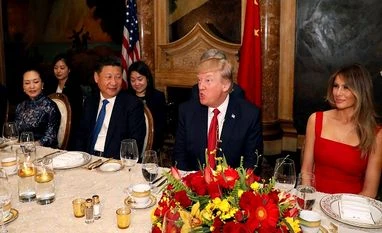
Donald Trump, Xi Jinping, Melania Trump, Peng Liyuan
President Donald Trump and Chinese President Xi Jinping, with their wives, first lady Melania Trump and Chinese first lady Peng Liyuan are seated during a dinner at Mar-a-Lago
Reuters Palm Beach, Florida
Last Updated : Apr 08 2017 | 11:27 AM IST
President Donald Trump pressed Chinese President Xi Jinping to do more to curb North Korea's nuclear program and help reduce the gaping U.S. trade deficit with Beijing in talks on Friday, even as he toned down the strident anti-China rhetoric of his election campaign.

Trump spoke publicly of progress on a range of issues in his first U.S.-China summit – as did several of his top aides – but they provided few concrete specifics other than China's agreement to work together to narrow disagreements and find common ground for cooperation.

As the two leaders wrapped up a Florida summit overshadowed by U.S. missile strikes in Syria overnight, Xi joined Trump in stressing the positive mood of the meetings while papering over deep differences that have caused friction between the world's two biggest economies.

Trump's aides insisted he had made good on his pledge to raise concerns about China's trade practices and said there was some headway, with Xi agreeing to a 100-day plan for trade talks aimed at boosting U.S. exports and reducing China's trade surplus with the United States.

Speaking after the two-day summit at Trump's Mar-a-Lago resort in Florida, U.S. Secretary of State Rex Tillerson also said that Xi had agreed to increased cooperation in reining in North Korea's missile and nuclear programs – though he did not offer any new formula for cracking Pyongyang's defiant attitude.

Trump had promised during the campaign to stop what he called the theft of American jobs by China. Many blue-collar workers helped propel him to his unexpected election victory on Nov. 8 and Trump is under pressure to deliver for them.

The Republican president tweeted last week that the United States could no longer tolerate massive trade deficits and job losses and that his meeting with Xi "will be a very difficult one."

On Friday, the unpredictable Trump not only set a different tone but also avoided any public lapses in protocol that Chinese officials had feared could embarrass their leader.

"We have made tremendous progress in our relationship with China," Trump told reporters as the two delegations met around tables flanked by large U.S. and Chinese flags. "We will be making additional progress. The relationship developed by President Xi and myself I think is outstanding.

"And I believe lots of very potentially bad problems will be going away," he added, without providing details.

"Agree with you 100 percent"

Xi also spoke in mostly positive terms.

"We have engaged in deeper understanding, and have built a trust," he said. "I believe we will keep developing in a stable way to form friendly relations ... For the peace and stability of the world, we will also fulfill our historical responsibility."

"Well, I agree with you 100 percent," Trump replied.

China's official Xinhua news agency said Xi had encouraged the United States to take part in the "One Belt, One Road" plan, Xi's signature foreign policy imitative aimed at infrastructure development across Asia, Africa and Europe, seen in some policy circles as a partial answer to the pivot to Asia strategy of Trump's predecessor Barack Obama.

Xi also hailed military to military exchanges and said China and the United States should "make good use of the dialogue mechanism to be established between the two countries' joint staffs of the armed forces", although Xinhua did not give further details.

But in a sign that rough spots remained, Tillerson afterwards described the discussions as "very frank and candid."

"President Trump and President Xi agreed to work in concert to expand areas of cooperation while managing differences based on mutual respect," he said.

After the meeting, Trump took Xi on a walk around the manicured grounds of his lavish Spanish-style complex. Trump could be seen chatting and gesturing to Xi, who did the same.

Tillerson said Trump had accepted Xi's invitation to visit China and that they also agreed to upgrade a U.S.-China dialogue by putting the two presidents at the head of the forum.

U.S. Commerce Secretary Wilbur Ross said the Chinese had expressed an interest in reducing China's trade surplus as a way of controlling their own inflation. "That's the first time I've heard them say that in a bilateral context," he said.

Ross declined to say whether the United States was ready to designate China a currency manipulator, however, referring to an upcoming report in which that issue would be addressed.

Although Trump during the presidential election campaign had pledged to label China a currency manipulator on the first day of his administration, he has refrained from doing so.

The highly anticipated U.S.-China summit was upstaged by U.S. missile strikes overnight against a Syrian air base from which Trump said a deadly chemical weapon attack had been launched earlier in the week. It was the first direct U.S. assault on the Russian-backed government of Syrian President Bashar al-Assad in six years of civil war.

The swift action in Syria could be interpreted as a signal especially to defiant nuclear-armed North Korea – and by extension, its ally China – as well as other countries like Iran and Russia of Trump's willingness to use military force. North Korea is developing missiles capable of hitting the United States.

Tillerson said Xi agreed with Trump that North Korea's nuclear advances had reached a "very serious stage."

He said Trump also raised U.S.concerns about China's activities in the South China Sea. Beijing is building and fortifying islands in pursuit of expansive territorial claims in the strategic waterway.

One subscription. Two world-class reads.

Already subscribed? Log in

Subscribe to read the full story →
*Subscribe to Business Standard digital and get complimentary access to The New York Times

Smart Quarterly

₹900

3 Months

₹300/Month

SAVE 25%

Smart Essential

₹2,700

1 Year

₹225/Month

SAVE 46%
*Complimentary New York Times access for the 2nd year will be given after 12 months

Super Saver

₹3,900

2 Years

₹162/Month

Subscribe

Renews automatically, cancel anytime

Here’s what’s included in our digital subscription plans

Exclusive premium stories online

  • Over 30 premium stories daily, handpicked by our editors

Complimentary Access to The New York Times

  • News, Games, Cooking, Audio, Wirecutter & The Athletic

Business Standard Epaper

  • Digital replica of our daily newspaper — with options to read, save, and share

Curated Newsletters

  • Insights on markets, finance, politics, tech, and more delivered to your inbox

Market Analysis & Investment Insights

  • In-depth market analysis & insights with access to The Smart Investor

Archives

  • Repository of articles and publications dating back to 1997

Ad-free Reading

  • Uninterrupted reading experience with no advertisements

Seamless Access Across All Devices

  • Access Business Standard across devices — mobile, tablet, or PC, via web or app

Next Story



