Twitter has finally acknowledged what any newcomer could have told the company within five minutes of signing up: The messaging service is too hard to use.
In reporting fourth-quarter financial results on Wednesday, Twitter executives said that the service's challenging design cut the rate of new-user growth and even prompted existing users to check their feed of messages less frequently.
The unexpected slowdown prompted investors to clip the wings of Twitter's high-flying stock, despite otherwise strong financial results. Shares fell as much as 18 per cent in after-hours trading as investors digested the company's first financial report since its initial public offering on November 7.
In a striking mea culpa, Twitter's CEO, Dick Costolo, told investors, "We simply need to make Twitter a better Twitter."
Discussing the results in a call with Wall Street analysts, he said that the company was working on improvements to its web software and mobile apps to make it easier for new users to sign up and current ones to find the most relevant information on topics they care about.
Twitter will also make it easier to send private messages between users, Costolo said - a reflection of the rising popularity of messaging services like Snapchat and Facebook's Messenger app.
Since its inception, Twitter has focused on the public sharing of textual messages, and its leaders have been reluctant to change its fundamental structure. The service presents users with an endless stream of 140-character messages in reverse chronological order, with no difference between the trivial and the important and no easy way to organise information by topic.
"Is your mom on Facebook? Yes. You ask that same question about Twitter, the answer is almost always no," said Robert Peck, an analyst at the brokerage firm SunTrust Robinson Humphrey. "The question is, Can they ever become mainstream like Facebook is?"
In the fourth quarter, the company made some effort to showcase photos and videos directly in the feed, which Costolo said had resulted in more engagement by users. The company plans to make other modest improvements this year.
"We will continue to invest in making Twitter a more visually engaging medium," he said. "It will be a combination of changes introduced over the year that we believe will begin to change the slope of the growth curve."
Over all, the company said it had 241 million monthly users globally in December, up from 232 million at the end of September. On average, users refreshed their Twitter feeds 613 times a month during the quarter, down 10 per cent from 685 times in the third quarter.
The problems with use of the site overshadowed an otherwise strong financial report that significantly exceeded Wall Street's expectations.
The company said revenue in the fourth quarter, which ended December 31, was $243 million, up 116 per cent from $112 million in the fourth quarter of 2012.
Twitter reported a net loss of $511 million, compared with a loss of $8.7 million a year ago.
However, using a closely watched measure of income that excludes stock-based compensation and other expenses, the company reported a profit of $9.7 million, or 2 cents a share, in the quarter, compared with a loss of $271,000 a year ago.
Wall Street analysts had expected the company to report a fourth-quarter loss of 2 cents a share and revenue of $218 million.
In an unusual move for a fast-growing company, Twitter gave a financial forecast for both the first quarter and all of 2014. The company said it expected first-quarter revenue of $230 million to $240 million. For the full year, it expects revenue of $1.15 billion to $1.2 billion, nearly double the $665 million it posted in 2013. It projected that profits from its core operations, excluding items like stock-option and depreciation expenses, would also double during 2014.
Those projections appeared to have disappointed some investors, many of whom had high expectations for the company ahead of the financial report. Since it first sold stock to the public, shares have been on a roller-coaster, rising from the public offering price of $26 to as high as $74.73 in December, even as many analysts said the stock was overvalued.
Shares closed at around $66 in regular trading on Wednesday, but went as low as $54 in after-hours trading after the results were announced.
The company impressed analysts with the strong growth in its advertising revenue. The company said it brought in $1.49 per 1,000 timeline views, or refreshes of its feed, compared with 97 cents in the third quarter.
"It shows that the people who are using Twitter are engaging with the ads," said Debra Aho Williamson, a principal analyst at the research firm eMarketer. "And a lot of advertisers do like to advertise on Twitter because of the engagement they get."
Advertisers are still experimenting with how to use Twitter most effectively, but the service generated strong results in the fourth quarter, said Tamara Gaffney, a principal analyst at the Adobe Digital Index, which tracks referral traffic to e-commerce sites.
The average revenue generated by a user clicking from Twitter to a retailer's website grew to 83 cents in the quarter, up 131 percent compared with a year ago, according to Adobe's analysis.
"Twitter is becoming a more important source of referrals for retailers," Ms. Gaffney said. "They are not only sending more traffic, but it's higher quality."
Twitter also released data on Wednesday that showed that people using Twitter while watching television shows were more likely to stay tuned in during the commercials, remember the ads and express an intent to buy the products advertised, compared with people simply watching the show.
Mark Mahaney, an analyst at RBC Capital Markets, said that it was important to remember that Twitter was a young company. Advertising revenue has been growing at triple-digit growth rates and is expected to continue to be robust in 2014.
"This company hasn't focused on engagement until recently," he said. "My guess is that the appeal of the service to users will improve over time."
©2014 The New York Times News Service

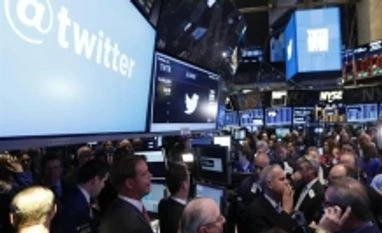 "User growth for Twitter starts to slow, and stock dips")


 Connect with us on WhatsApp