Home / World News / Violation of international norms can be disruptive: US on South China Sea
Violation of international norms can be disruptive: US on South China Sea
White House also warned against provocative and inflammatory comments
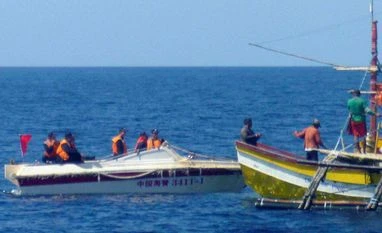
In this Feb 27, 2015, photo, provided by Filipino fisherman Renato Etac, Chinese Coast Guard members approach Filipino fishermen near Scarborough Shoal in the South China Sea. Photo: AP/PTI
After China refused to abide by an international tribunal's ruling against its expansive claim in the strategic South China Sea, the US has warned that violation of international norms by bigger countries can be disruptive and asserted that the verdict is binding and final.
The White House also warned against provocative and inflammatory comments.
"We believe that this should not be a time for provocation or inflammatory comments or actions. Our hope is that this is not an inflection point toward a deeper conflict, but rather is an inflection point toward the peaceful and diplomatic resolution of competing claims in the South China Sea," White House Press Secretary Josh Earnest said on wednesday.
"We want to protect billions of dollars of commerce that flows through the South China Sea. We want to protect the transit lanes and the shipping lanes in that region of the world. And we want to make sure that those competing claims don't devolve into some sort of military confrontation. That's why we've taken the position that we have." he said.
China on wednesday raised tensions in the South China Sea, through which a third of world's trade passes annually, by threatening to declare an air defence identification zone (ADIZ) over disputed waters. Move comes after the Hague's Permanent Court of Arbitration ruling on Tuesday saying that China had no legal basis for its 'nine-dash line', which lays claim to almost all of the South China Sea.
Chinese President Xi Jinping said that China would refuse to accept the decision.
Its Assistant Foreign Minister Liu Zhenmin on Wednesday said if China's security is threatened in the South China Sea, it has the right to declare an ADIZ over disputed waters, and also warned against making it a region of war.
But Earnest said there are norms that must be observed to ensure the success of our interconnected world.
He said the US was not a claimant in the South China Sea and does not support or oppose any specific claims. Rather, Earnest said, the US has strongly asked those with competing claims to resolve the dispute peacefully and through diplomacy.
The White House press secretary, however, said that the Law of the Sea Convention, to which both China and the Philippines are signatories, has followed the process that's specified in the convention. "They've issued this ruling, and that's why it's the US' view that this tribunal finding is binding and final," he informed.
In 2013, the Philippines challenged China's attempts to establish control over an area encompassing nearly 90% of the South China Sea. It was the first time the Chinese government had been summoned before the international justice system.
The tribunal has rejected China's argument that it enjoys historic rights over most of the South China Sea.

 "Violation of international norms can be disruptive: US on South China Sea")


