How will Trump's trade war end? The US-UK war of 1812 may have the answer

The war of 1812 between US and United Kingdom might offer a more realistic comparison, say trade historians
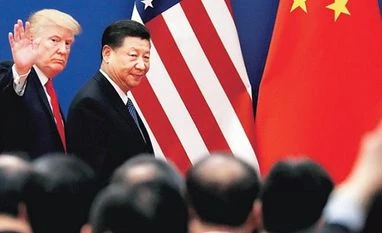
Donald Trump and Xi Jinping. Photo: Reuters
Shawn Donnan | Bloomberg
3 min read Last Updated : May 22 2019 | 9:56 AM IST
President Donald Trump’s escalating trade war against China has drawn plenty of historical parallels. 

The Chinese like to invoke the 19th-century Opium Wars and the national humiliation that followed. 

In the U.S. the comparison is increasingly to the Cold War against the Soviet Union, or the 1980s trade wars against Japan.

Ask Douglas Irwin, author of “Clashing Over Commerce: A History of U.S. Trade Policy,” however, and he argues the most accurate comparison from an American perspective is the War of 1812.

That conflict was born out of a trade war (a British embargo of France) and fought at least partly as a trade war (a British blockade of America). It also yielded another trade war.

Once the war was won, it prompted calls for a decoupling from a British economy with which America’s was deeply integrated, Irwin said. And like the current calls related to China, that was based on a bigger existential question for the U.S.

“We wanted to reduce our dependence on Britain, which was viewed as an enemy power,’’ said Irwin, a professor at Dartmouth.

Higher Stakes

In response, Washington began imposing higher tariffs on British goods to protect what it declared to be strategic U.S. industries. 

That action grew into manufacturers’ calls for protection from cheap British imports that would become a feature of political debate through the 19th century.

You can argue today’s economic stakes are undoubtedly much higher in value terms. But the War of 1812 and the dependence on British industry at the time presented a legitimate existential question. The British got all the way to Washington and set fire to the White House in 1814, after all.

Irwin is not hopeful about the future of Trump’s China trade war. He believes a resolution in the short term is unlikely. 

“If you are really asking for economic regime change that’s something no country, particularly one that is as nationalistic and proud as China, is going to deliver on,’’ he said.

Irwin fears it could all end in a new technology Cold War. His problem with the comparison with the conflict with the Soviet Union is that Moscow never posed a real economic challenge to the U.S. And with Japan the inverse was true.

“That is where China is really different,’’ he said.

The 1980s trade wars against Japan were also fought in a very different way, Irwin argues.

The Trump administration’s emphasis so far has been on tariffs and other defensive economic tools, he said. In the Reagan administration the focus was as much on offensive measures such as boosting research and development and American competitiveness. 

Reagan was also a vocal defender of free trade.

Complicated as it seemed at the time, the friction with Japan over everything from cars to televisions and semiconductors was simpler to deal with. Yet it still took time to sort out. 

That bodes badly for anyone hoping for a quick resolution with China.

“There were years of discussions and they were a much more market-oriented economy than China,’’ Irwin said. 

“And here the stakes are bigger.’’

One subscription. Two world-class reads.

Already subscribed? Log in

Subscribe to read the full story →
*Subscribe to Business Standard digital and get complimentary access to The New York Times

Smart Quarterly

₹900

3 Months

₹300/Month

SAVE 25%

Smart Essential

₹2,700

1 Year

₹225/Month

SAVE 46%
*Complimentary New York Times access for the 2nd year will be given after 12 months

Super Saver

₹3,900

2 Years

₹162/Month

Subscribe

Renews automatically, cancel anytime

Here’s what’s included in our digital subscription plans

Exclusive premium stories online

  • Over 30 premium stories daily, handpicked by our editors

Complimentary Access to The New York Times

  • News, Games, Cooking, Audio, Wirecutter & The Athletic

Business Standard Epaper

  • Digital replica of our daily newspaper — with options to read, save, and share

Curated Newsletters

  • Insights on markets, finance, politics, tech, and more delivered to your inbox

Market Analysis & Investment Insights

  • In-depth market analysis & insights with access to The Smart Investor

Archives

  • Repository of articles and publications dating back to 1997

Ad-free Reading

  • Uninterrupted reading experience with no advertisements

Seamless Access Across All Devices

  • Access Business Standard across devices — mobile, tablet, or PC, via web or app

Next Story



