What to expect in UK Chancellor Jeremy Hunt's plan to fix fiscal hole

Prime Minister Rishi Sunak's finance minister is trying to identify £50 billion ($56 billion) of spending cuts and tax increases to get debt falling as a proportion of gross domestic product

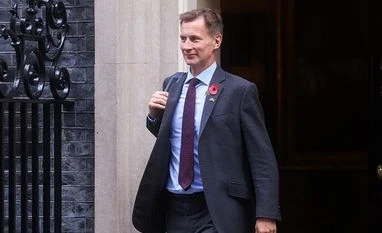
Jeremy Hunt, UK Chancellor
Photo: Bloomberg
Joe Mayes | Bloomberg
4 min read Last Updated : Nov 06 2022 | 6:43 AM IST
UK Chancellor of the Exchequer Jeremy Hunt will announce a major economic package on Nov. 17 as he tries to stabilize public finances and recover credibility lost in the turmoil of Liz Truss’s ill-fated administration.
 
Prime Minister Rishi Sunak’s finance minister is trying to identify £50 billion ($56 billion) of spending cuts and tax increases to get debt falling as a proportion of gross domestic product over the medium-term. Though no final decisions have been taken, here’s what could happen:

Higher windfall tax on energy profits
 
Hunt is considering extending the UK’s windfall tax on oil and gas companies, a levy first introduced by Sunak in May when he was chancellor. Hunt is looking at a significant expansion of the tax, raising the rate to 30% from 25%, and extending it to 2028 from 2026. He’s also considering applying it to electricity generators, according to a person familiar with the matter. 

Such a move would increase revenue from the existing tax by 50% to £40 billion over five years, the Times newspaper reported, citing internal government estimates, though that’s dependent on volatile energy prices.

Freeze income tax thresholds
 
Hunt is due to extend a current four-year freeze on income tax thresholds and allowances, which was introduced by Sunak in 2021, raising about £5 billion a year by 2027-28, the Financial Times reported. 

Due to high inflation, the freeze has the effect of dragging more people into the tax system or into higher tax bands, boosting revenue for the Treasury.

Increase capital gains tax
 
The chancellor is also weighing an increase in the headline rate of capital gains tax, a levy on profits from the sale of assets. Current rates range from 10% to 28%, and a one percentage-point increase in the higher rate would be worth about £145 million, according to Treasury estimates.

He’s also considering cutting reliefs and allowances. 

Hit shareholders
 
The tax-free allowance for dividend income is in line to be cut, two people familiar with the matter said, a move that would hit shareholders and owner-managers of businesses. It’s currently set at £2,000, but reducing it to £1,000 would raise about £455 million a year, according to Treasury calculations.

Hunt is also considering a 1.25 percentage-points increase in dividend tax rates, the Financial Times reported.

Freeze foreign aid
 
Hunt is expected to maintain the foreign aid budget at 0.5% of GDP for another two years, instead of increasing it to 0.7% in 2024-25 as Sunak had previously promised. The UK had spent 0.7% of GDP on foreign aid but cut the amount to 0.5% during the coronavirus crisis. 

The move would save £4 billion a year, the Telegraph reported.

Cuts to government spending
 
Ministries are braced for real-terms spending cuts. The Treasury is considering pay rises of 2% across the public sector in 2023-2024, meaning below-inflation increases for nurses, teachers and police officers, the Times reported.

Cuts to spending on capital projects are also in prospect. Cabinet minister Michael Gove has indicated long-term projects could be delayed or axed.

Cut the bank surcharge
 
Hunt and Sunak have a major decision to make about the bank surcharge, which is an 8% levy on bank profits in addition to the standard corporation tax rate. As chancellor, Sunak had said he would cut the 8% levy to 3%, because corporation tax is due to rise from 19% to 25% and he didn’t want the UK’s banking sector to become uncompetitive. 

Hunt is expected to stick to Sunak’s plan to cut the surcharge to 3%, the Sunday Times reported, citing unidentified government officials.

Decisions on welfare, pensions
 
The government also has to make politically contentious decisions about whether to rise welfare and pension payments in line with inflation -- currently at 10% -- or aligned to the lower measure of earnings growth. Opting for the latter would save £13 billion, but would likely trigger a major political backlash.

Sunak and Hunt plan to reveal a stealth tax raid on pensions later this month, with the pension lifetime allowance set to be frozen for two more years, the Telegraph newspaper reported. A rise would be in line with prices delayed from 2025 to 2027, meaning 2 million savers now face tax charges of up to 55% on their retirement funds by the end of that period, according to expert analysis.

A Saturday edition of the Telegraph said ministers have discussed reducing the rate at which income tax relief is applied to higher-rate taxpayers, from 40p to a flat rate as low as 20p. They’re also considering increasing the number of very high earners whose income tax relief is cut even further.

One subscription. Two world-class reads.

Already subscribed? Log in

Subscribe to read the full story →
*Subscribe to Business Standard digital and get complimentary access to The New York Times

Smart Quarterly

₹900

3 Months

₹300/Month

SAVE 25%

Smart Essential

₹2,700

1 Year

₹225/Month

SAVE 46%
*Complimentary New York Times access for the 2nd year will be given after 12 months

Super Saver

₹3,900

2 Years

₹162/Month

Subscribe

Renews automatically, cancel anytime

Here’s what’s included in our digital subscription plans

Exclusive premium stories online

  • Over 30 premium stories daily, handpicked by our editors

Complimentary Access to The New York Times

  • News, Games, Cooking, Audio, Wirecutter & The Athletic

Business Standard Epaper

  • Digital replica of our daily newspaper — with options to read, save, and share

Curated Newsletters

  • Insights on markets, finance, politics, tech, and more delivered to your inbox

Market Analysis & Investment Insights

  • In-depth market analysis & insights with access to The Smart Investor

Archives

  • Repository of articles and publications dating back to 1997

Ad-free Reading

  • Uninterrupted reading experience with no advertisements

Seamless Access Across All Devices

  • Access Business Standard across devices — mobile, tablet, or PC, via web or app

Topics :Rishi SunakUK govt

Next Story





