It’s an interesting paradox that ordinary people asked to choose the best form of government don’t necessarily choose democracy — the only form structured around how they feel about such questions. A 38-country survey published by Pew Research Center on Monday shows most people prefer a technocracy, with a minority favouring a type of military or civilian authoritarianism.
Pew asked 41,953 people earlier this year to judge if five forms of government — representative democracy, direct democracy, or rule by either experts, a strong leader or the military — would, in their opinion, be good for their country. More than three-quarters said they liked representative democracy and two-thirds praised direct voting; none of the other options won an overall majority in the 38 countries. That should be enough to satisfy a pro-democracy optimist. The data, however, is more complex.
Discarding the direct democracy option, Pew classified respondents as those committed to representative democracy (those who only support this type of government), those who are positive about at least one other type and those who only support a non-democratic option or two. Sweden turned out to be the only country with a majority — 52 per cent — strongly committed to representative democracy. Even in countries with strong traditions of popular rule, such as the US, Canada, the Netherlands, the UK or France, most people are willing to entertain alternatives, tacitly disagreeing with Winston Churchill’s contention that “democracy is the worst form of government except for all those other forms that have been tried from time to time.”
Majorities in France, Southern European countries, Hungary, South Korea, most Middle Eastern and Latin American nations say they are unhappy with how democracy works in their country. But then, as the Pew researchers point out, happiness with the democratic order is closely correlated with how democratic a country actually is (according to the Economist’s democracy index), with wealth, economic growth and support for the ruling political parties. People’s willingness to consider alternatives to representative government is also correlated with education (predictably, those with less of it have more respect for a strong hand and for the military). Pew didn’t do an age breakdown, otherwise they could have discovered, as Roberto Stefan Foa and Yascha Mounk did last year, that millennials find it less essential than previous generations to live in a democratically-governed country; but then, today’s young are more economically disadvantaged than their parents, so perhaps there’s an economic explanation for the phenomenon.
Most people can’t think of government forms in the abstract. Winners (in every sense — those who are wealthier and more used to freedom, those with more schooling, those who voted for the winning party) are generally happier with the status quo than losers, and that affects their judgment.
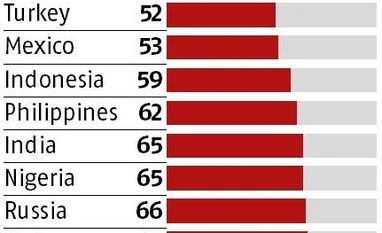
What’s truly striking about the Pew findings, however, is what kind of experiment people would favour. The only nondemocratic form of government that attracts majorities in some countries is technocracy, in which experts, not elected politicians, determine how to run a nation. The list of countries where that’s a common belief is telling.
It’s in advanced democracies that experts’ allure has faded. When Michael Gove, currently the UK environment minister, said last year that “people in this country have had enough of experts,” he was right in the sense that British people didn’t want an expertocracy. They still don’t: 54 per cent believe it would be bad for the UK. Large majorities in Europe believe ordinary people should be more empowered, voting on major national issues — a preference that helps populist parties, which generally call for more referendums. But in countries where democracy is young, flawed or fragile, majorities would consent to technocratic rule. It’s usually second best after representative democracy in Pew respondents’ view, but it’s clearly preferable to strongman or military rule.