Wikipedia Turkey's first censorship target after referendum; what next?

Turkey joined China as one of the few countries to order a complete block on Wikipedia
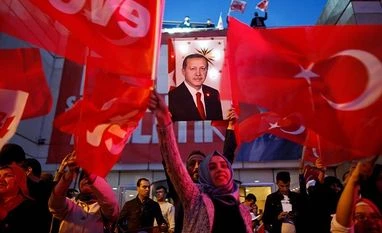
Supporters of Justice and Development party (AK) wave Turkish flags and hold a poster of Turkish President Recep Tayyip Erdogan outside its offices in Istanbul. Photo: PTI
Arzu Geybullayeva | Global Voices
Last Updated : May 06 2017 | 1:47 PM IST
Just two weeks after a referendum in which voters narrowly approved far-reaching constitutional amendments that will increase the power of the presidency, a Turkish court ruled that the volunteer-driven international online encyclopaedia Wikipedia should be blocked in Turkey.

Amid growing tension between the pro and anti-government camps, the decision provided citizens with yet another snapshot of their future under President Recep Tayyip Erdogan and his ruling AKP party as they adjust to growing political upheaval and the extension of emergency rule in the country by a further three months.

Hurriyet Daily News reported that the website ban was ordered by an Ankara court on April 29 “after the site’s administration refused to remove two English language pages which claimed that Turkey channelled support to jihadists in Syria”.

The Ministry of Transport, Maritime Affairs and Communications Ministry appeared to confirm this viewpoint when it said the site was blocked for “becoming an information source with acting with groups conducting a smear campaign against Turkey in the international arena.”

These are the lines that got #Wikipedia blocked in Turkey. All about the illegal weapons transfer of the Turkish Intelligence though Syria. https://t.co/GlDKZnmnWR
Keeping China company

As a result, Turkey joined China as one of the few countries in the world to order a complete block on Wikipedia, rather than simply censoring individual pages. The sledgehammer attack on the resource echoes the zeal with which the government seemingly blocked Twitter after Erdogan promised to “wipe out” the social media service in 2014.

According to a Wikipedia page on the topic of the website's censorship by countries across the world, previous censorship attempts by Turkey had only been partial and apparently focused on Turkish-language articles about human genitalia.

The block comes at a time of deepening political schism in Turkey, after Erdogan lashed out against OSCE/ODIHR observers and their reports of vote fraud in the country's tightly contested referendum.

President Erdogan, Turkey's leading politician for the last 14 years, publicly told them as well as other international actors and critics of the government to “know your place”.

Enemy of the Internet

The AKP government's strong aversion to the Internet can be traced back at least as far as the Gezi park protests in 2013 in which social networks helped mobilize opposition to the government in one of the first major tests of Erdogan's enduring leadership.

Just months later, they had reason to hate it some more after recordings allegedly capturing Erdogan and his son discussing illicit financial schemes went viral across YouTube and Twitter, triggering the Turkish leader's now infamous broadside against the micro-blogging service Twitter.

Turkey has blocked both YouTube and Twitter in the past, the latter on multiple occasions. According to EngelliWeb (a platform no longer available online that tracked websites blocked since 2006) there are over 100,000 blocked websites in Turkey today.

Internet speeds have slowed considerably, meanwhile, and are especially sluggish during anti-government rallies, counter-extremism operations or elections, pointing to likely interference by state actors.

In November 2016, the government shut down the internet in the Kurdish-populated south-east of the country for 10 days.

Turkish netizens were quick to turn to Twitter to channel their frustrations with the court decision blocking Wikipedia.
 
"World's most heavily used information source Wikipedia blocked in Turkey. Whats the aim, to stay uninformed?"

"I have been banned. I have been in hiding all the time. Good morning, I am leaving (play on the words of a popular pop song)."


"The darkness that blocked Wikipedia…"

"Wikipedia blocked, marriage TV shows shut down. Even Hames Harden would not have been able to do all these blogs."

The marriage programs mentioned in this tweet refer to a court order also on April 29 that blocked reality dating programs which are popular in Turkey, citing these TV shows as unfit for Turkish traditions and customs.

On the same day, another 3,900 people were dismissed from their jobs, including more than 400 academics for alleged ties to Erdogan's arch-nemesis Fethullah Gulen, who Ankara accuses of engineering a bloody coup attempt in the country last year.

Since the coup took place 120,000 people have been sacked from both public and private sector jobs, and as many as 40,000 arrested, mostly on the basis of suspected affiliations to Gulen, an Islamic preacher and educator that once wielded formidable behind-the-scenes influence in Turkey.

The fact that Erdogan's “Yes’ campaign secured 51.41% of the vote indicates that a large part of the country is supportive of what amounts to a giant social engineering project to permanently change the face of the Turkish republic.

For the 48.59% who voted “No”, cue disillusion, alienation and a world in which circumvention tools are needed to access the internet's largest, crowd-sourced educational resource.

One subscription. Two world-class reads.

Already subscribed? Log in

Subscribe to read the full story →
*Subscribe to Business Standard digital and get complimentary access to The New York Times

Smart Quarterly

₹900

3 Months

₹300/Month

SAVE 25%

Smart Essential

₹2,700

1 Year

₹225/Month

SAVE 46%
*Complimentary New York Times access for the 2nd year will be given after 12 months

Super Saver

₹3,900

2 Years

₹162/Month

Subscribe

Renews automatically, cancel anytime

Here’s what’s included in our digital subscription plans

Exclusive premium stories online

  • Over 30 premium stories daily, handpicked by our editors

Complimentary Access to The New York Times

  • News, Games, Cooking, Audio, Wirecutter & The Athletic

Business Standard Epaper

  • Digital replica of our daily newspaper — with options to read, save, and share

Curated Newsletters

  • Insights on markets, finance, politics, tech, and more delivered to your inbox

Market Analysis & Investment Insights

  • In-depth market analysis & insights with access to The Smart Investor

Archives

  • Repository of articles and publications dating back to 1997

Ad-free Reading

  • Uninterrupted reading experience with no advertisements

Seamless Access Across All Devices

  • Access Business Standard across devices — mobile, tablet, or PC, via web or app

Next Story



