
World more unpredictable than during the Cold War: UN chief Guterres
Antonio Guterres has said the current world is "much more chaotic, much less predictable" than during the Cold War between the former Soviet Union and the United States
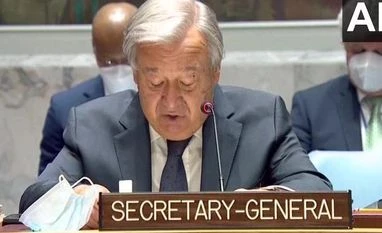 "World more unpredictable than during the Cold War: UN chief Guterres")
WebinarsNew
Deep DiveNew
Explore Business Standard
Antonio Guterres has said the current world is "much more chaotic, much less predictable" than during the Cold War between the former Soviet Union and the United States
UN Secretary-General Antonio Guterres has said the current world is "much more chaotic, much less predictable" than during the Cold War between the former Soviet Union and the United States, and it's dangerous because there are no "instruments" to deal with crises.
He said in a wide-ranging press conference on Friday that the Cold War was between two opposing blocs where there were clear rules and mechanisms to prevent conflict. It "never became hot because there was a certain level of predictability", he said.
He said he wouldn't call the dangerous situation today a Cold War or a Hot War but probably "a new form of tepid confrontation".
As he starts his second term as UN secretary-general, Guterres said in an Associated Press interview on Thursday that the world is worse in many ways than it was five years ago because of the COVID-19 pandemic, the climate crisis and geopolitical tensions that have sparked conflicts everywhere but unlike US President Joe Biden he thinks Russia will not invade Ukraine.
At the press conference, Guterres said his message to Russian President Vladimir Putin "is that there should not be any military intervention" in Ukraine.
"I am convinced it will not happen, and I strongly hope to be right," he said.
The UN chief spoke after US Secretary of State Antony Blinken and Russian Foreign Minister Sergey Lavrov met in Geneva on the crisis over Ukraine which has seen Moscow deploy tens of thousands of troops on its border and Western nations sending military hardware to Kyiv.
Expectations were low for a breakthrough and there was none, but the top US and Russian diplomats agreed to meet again.
"What for me is essential is that this dialogue leads to a good solution and that that good solution is that there is de-escalation and this crisis ends," Guterres said. "That is our objective. I've been saying that I strongly hope that diplomacy will prevail."
Guterres reiterated in the AP interview that the U.N. Security Council, which does have the power to uphold international peace and security including by imposing sanctions and ordering military action, is divided, especially its five veto-wielding permanent members.
Russia and China are often at odds with the United States, Britain and France on key issues, including Thursday on new sanctions against North Korea.
The secretary-general reiterated at the news conference that splitting the world in two -- with the United States and China creating rival economic systems and rules, each with dominant currency, its own Internet, technological strategy and artificial intelligence -- must be avoided "at all costs".
"I always advocated for the need for a unified global market, a unified global economy," Guterres said. "At the present moment there are a number of differences and I've been advocating both with the US and China on the importance of a serious dialogue and a serious negotiation on the aspect of trade and technology in which the two countries have... different positions."
He said his aim is to see the two leading economic powers "overcome those difficulties and to be able to establish that global market in which all can cooperate and all can benefit."
Guterres spoke to reporters after presenting his priorities for 2022 to diplomats from the UN's 193 member nations in the General Assembly and assessing the global landscape which he called "not a pretty picture."
"I see a five alarm global fire," the secretary-general said.
"Each of the alarms is feeding off the others," he said. "They are accelerants to an inferno."
He cited inequity and injustice in tackling the COVID-19 pandemic, "a global economic system rigged against the poor," insufficient action on "the existential climate threat" and "a wild west digital frontier that profits from division".
Guterres said all these "social and economic fires" are creating conflicts and unrest around the world, and all of them are fuelling mistrust and people's lost faith in institutions and their underlying values.
"In every corner of the world, we see this erosion of core values. Equality. Justice. Cooperation. Dialogue. Mutual respect," the secretary-general said.
He warned that injustice, inequality, mistrust, racism and discrimination "are casting dark shadows across every society" and said all nations must restore "human dignity and human decency" and "prevent the death of truth".
"We must make lying wrong again," Guterres said.
(Only the headline and picture of this report may have been reworked by the Business Standard staff; the rest of the content is auto-generated from a syndicated feed.)
First Published: Jan 22 2022 | 8:17 AM IST


 Connect with us on WhatsApp