
Yoshihide Suga poised to win party vote for Japan's next prime minister
Yoshihide Suga is poised to win Japan's ruling party leadership vote on Monday, virtually guaranteeing him parliamentary election as the country's next prime minister
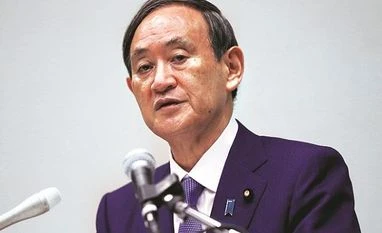 "Yoshihide Suga poised to win party vote for Japan's next prime minister")
Explore Business Standard
Yoshihide Suga is poised to win Japan's ruling party leadership vote on Monday, virtually guaranteeing him parliamentary election as the country's next prime minister
Yoshihide Suga is poised to win Japan's ruling party leadership vote on Monday, virtually guaranteeing him parliamentary election as the country's next prime minister.
The ruling Liberal Democratic Party is choosing its new leader in an internal vote to pick a successor to Prime Minister Shinzo Abe, who announced last month that he would resign due to health problems.
The expected victory in the party vote by Suga, currently the chief Cabinet secretary and Abe's right-hand man, all but guarantees his election in a parliamentary vote because of the majority held by the Liberal Democrats' ruling coalition.
Media reports said early vote counting of local representatives on Monday indicated Suga had an overwhelming lead over the two other contenders former Defence Minister Shigeru Ishiba and former Foreign Minister Fumio Kishida.
The voting by nearly 400 ruling party lawmakers begins later Monday, with results expected within hours.
Suga gained the support of party heavyweights and their wing members early in the campaign on expectations that he would continue Abe's policies. That his victory appears to be a done deal has raised criticism from inside and outside the party that the process is undemocratic and murky.
Suga has said his top priorities are fighting the coronavirus and turning around an economy battered by the pandemic. He repeatedly has noted achievements under the Abe-led government when asked about various policies.
Despite his low-key image, Suga is actually known for his iron-fist approach to getting jobs done as a policy coordinator and influencing bureaucrats by using the centralized power of the prime minister's office.
Suga says that he is a reformist and that he has worked to achieve policies by breaking territorial barriers of bureaucracy. He credited himself for those efforts in achieving a booming foreign tourism industry in Japan, lowering cellphone bills and bolstering agricultural exports.
Compared to his political skills at home, Suga has hardly travelled overseas, and his diplomatic skills are unknown, though he is largely expected to pursue Abe's priorities.
In addition to the coronavirus and the economic fallout, Suga stands to inherit several other challenges, including China, which continues its assertive actions in the East China Sea. He also will have to decide what to do with the Tokyo Olympics, which were pushed back to next summer due to the coronavirus. And he will have to establish a good relationship with whoever wins the US presidential race.
(Only the headline and picture of this report may have been reworked by the Business Standard staff; the rest of the content is auto-generated from a syndicated feed.)
First Published: Sep 14 2020 | 11:26 AM IST

