Voltas, today, is best recalled for its room air conditioners that have given a tough fight to multinational companies in consumer durables.
Its inception was in 1954, when Swedish Volkart Brothers founded a joint venture with Tata Sons. But the Swedish partner soon left the company, and it became a fully-owned Tata Group firm.
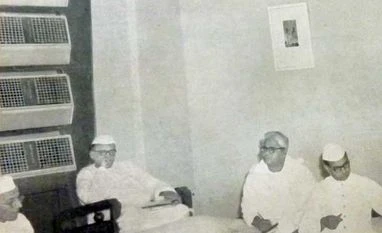
Forty years ago, it was busy diversifying, as the restrictions of the Licence Raj did not allow it to ramp up its production in its core business of ACs beyond a limit. Hence, to grow, Voltas entered a plethora of new businesses such as manufacturing and marketing of consumer products, food and beverage, agro-chemicals, molded furniture and industrial equipment.
Since then it has retained the manufacturing and marketing of cooling appliances and industrial equipment, and also executes engineering projects.
In consumer durables, while Voltas had window ACs as the core product (a popular variant being Crystal), it diversified by launching refrigerators under a brand called Opal, in 1970. It also acquired Hyderabad Allwyn in 1993 and doubled its fridge-making capacity to 500,000 units. Voltas had a pretty good run with such diversification in those days.
But the world changed for Voltas when the government allowed MNCs in, under its liberalisation initiative. That meant competition with global giants having deep pockets by the mid-90s. Voltas saw an opportunity in this, as it started making washing machines in collaboration with Korean chaebol, Samsung, in 1994. It also got into contract manufacturing of fridges for LG in 1997.
But by 2000, Voltas decided to divest its white goods business to a JV with the Swedish giant, Electrolux. It first transferred Voltas branded fridges and washing machines and then the Allwyn brand to the JV. But the JV was not meant for the long term, as the MNC started setting up its own manufacturing units. Besides, Voltas had started losing out on its core AC business. This is when it decided to do away with diversification in durables. It exited the fridge and washing machine segment.
The room AC market was not easy by then. First, the American giant, Carrier, had entered India in 1993, followed by Korean giants, LG and Samsung, and then the Japanese Hitachi. Their flurry of new products pushed Voltas out of the top-5 manufacturers, according to market share. The company eventually saw profitability shrink that led to a senior-management exodus in 2006-07.
"It was a do or die situation for us," remembers Pradeep Bakshi, president and chief operating officer at Voltas, who was part of a new team entrusted to turn around the company. "Obviously something drastically different was needed, which could address a clear consumer need that other brands were ignoring," says Bakshi. Market research told them that the AC user's concern about high electricity bills were not being addressed.
It launched energy-efficient ACs with 'Star' ratings from the Bureau of Energy Efficiency, then. At the same time, the sales and distribution was overhauled. Till 2006, it sold through sales and service dealers, rather than retailers. It made its ACs available off-the-shelf in the retail channel. Customer touch-points were multiplied to number 9,700, from 2,700, including distributors and retailers.
But the 'Star' rating was later made mandatory for all durables brands, so the company looked for new need-gaps and launched the all-weather AC, based on new customer insights. It was developed and promoted as a product that could provide cooling in hot summers, warmth in cold winters and lower humidity in the monsoons.
With this, the company gained pole position again in May, 2012, according to market research firm GFK Nielsen's survey of volume sale at mutli-brand outlets.
The company still enjoys the leadership position in the category, with nearly one-fifth market share in multi-brand outlets, which is about 90 per cent of the total market. In overall volumes, however, it was neck and neck with LG last year. "Voltas learnt the game very quickly," says Rajeev Karwal, who brought LG to India in 1997 and also served as CEO, Electrolux Kelvinator, and now heads Milagrow that deals in robots. "Good at innovation, it offered better quality products at competitive pricing," he says.

 "40 years ago...And now: Diversified Voltas' core saved it")


 Connect with us on WhatsApp