Classroom innovation
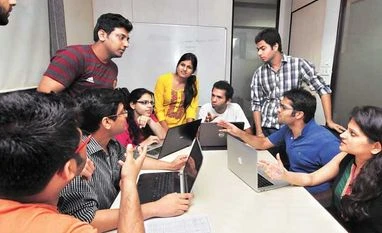
Collaborative learning helps improve social interaction skills, greater acceptance of others, and a greater sense of "community" in the class
Rupa Basu The 21st century with its revolutionary changes in information and communication technology has put new pressures on the higher education system for the development of special skills and competencies among students. The Indian higher education system is one of the largest with respect to student enrolment, next only to China and the US. While the last three decades have seen a huge increase in the provision of higher education in India, the quality of education imparted by our colleges and universities has often been a matter of concern.
Behaviorism is the predominant theory on which most of the teaching and learning processes have been based since the 1960s. Its basic premise is that behaviour can be predicted and controlled and if teachers provided the correct stimuli, students will learn. However, after years of implementation, behaviorism could not produce the desired effects within the complex context of the classroom and teachers were also left feeling cheated by a system that blamed them for students' failure to learn.
Following vast research on different strategies of imparting knowledge, constructivism has emerged as the largely accepted theory of learning. According to the constructivist theory students learn from being active learners in collaborative settings and from constructing ideas and concepts based on their prior knowledge and experiences. Constructivist theory places the student at the center of the learning experience and focuses on knowledge construction, not reproduction. Whereas in traditional classrooms knowledge is inert, in a constructivist classroom it is an active and interactive process.
In the traditional mode of instruction, student concentration is found to decline after 10-15 minutes during lectures and class participation is often unbalanced in favor of the most knowledgeable students who are most willing to respond in front of their peers. One of the core strategies in constructivist classrooms is to promote student participation and collaborative learning. Students assist each other in understanding content and this helps broaden their perspectives on issues or problems. This also increases student retention and limits anxiety. Collaborative learning provides for improvement of social interaction skills, greater acceptance of others, and a greater sense of "community" in the class. This also develops confidence, respect for others, etiquettes and social skills among learners. This is particularly true for college goers.
Some collaborative activities that can be done in the classroom are: (1) Experimentation where students individually perform an experiment and then come together as a class to discuss the results; (2) Field trips by students that allow them to put the concepts and ideas discussed in class in a real-world context; (3) Working together on research projects in which students research a topic in groups of two-four and then present their findings to the class; (4) Making or editing films and then presenting and discussing them to provide an audio-visual dimension into the learning experience.
As the world moves towards digital media, e-learning tools are also getting integrated in the education process. The students can not only exchange their thoughts and information over email and by connecting in chat rooms; they can collaborate effectively and with the use of tools like Google Docs and Wikis supports both faculty and student needs in terms of greater flexibility, convenience and increased efficiency. These online collaborative tools provide scope for communication and interaction through synchronous and asynchronous exchange of materials that are rich in media and varied in format. Learner interaction can be heightened with the use of internet-enabled smartphones, tablets and laptops.
As we look at ways to dramatically enhance education in this millennium, we must engage our students in ways that make them capable of dealing with complex problems in imaginative ways.
The author is assistant professor in economics at Kamala Nehru College

 "Classroom innovation")


 Connect with us on WhatsApp