Siddhartha Pahwa, the chief executive officer of Meru Cabs, is a relieved man. India's first radio cab service, launched in 2006, seems to have weathered the "shock treatment" given by its drivers a couple of years ago, with a month-long strike over various issues in cities like Mumbai. The lessons learnt from that unrest have gone into tweaking the business model. It has allowed Meru to record double digit operating profit margins for the first time in 2013-14, in eight years of existence.
"For the last 24 months, we have reaped return on every Meru cab that hits the road. Even after paying EMIs on new cabs, Meru had an Ebitda (earnings before interest, tax, depreciation and amortisation) of Rs 50 crore in 2013-14," Pahwa says. According to him, Meru clocked revenues of Rs 450 crore, making for an Ebitda margin of 11 per cent. It has a 20-per-cent return on capital employed.
When Meru was launched, it owned the fleet. Meru drivers had to pay Rs 1,200-1,300 per day to the management and were promised at least 25 assignments a day. "We had to invest our money to create an ecosystem where customers are given a comfortable taxi ride and the drivers did not have the capital to own such cars. That's why we leased our cars to drivers, contrary to the system that exists in foreign countries (where drivers own the cars and subscribe to a branded service)," he says.
However, the strike by drivers in 2012 forced Meru to rethink its business. Now, 50 per cent of its 7,500 cars are owned by the drivers themselves, across three brands - its flagship Meru (Rs 20 per km in Mumbai), Meru Plus (Rs 23 per km) and Genie (Rs 15 per km onwards). Owning the cars makes the drivers more responsible for the service. Meru accepts 15 per cent share of the fares from each driver.
Besides bringing in passengers, Meru facilitates bank loans for the drivers to buy the cars. Around 10 per cent already have the cars in their name, while most of the rest pay EMIs to Meru which forwards it to the banks to repay the loans. As many as, 3,750 of its regular Meru drivers still drive cars that are owned by it (out of the 5,000 cars under Meru).
Competition like Mega, Easy and Tab Cab still own fleets. More recent entrants such as Ola act as aggregators. It lets drivers use the brand and shares revenues.
Recently, Ola Cabs raised Rs 250 crore from hedge fund Steadview Capital and venture capital firm Sequoia Capital. Ola is present in nine cities with 11,000 cabs and claims to have 12,000 bookings per day, against 30,000 by Meru.
Now, a budget Meru The company launched Genie, a low-cost taxi service in 2014. Compared to Meru and Meru Plus that have sedans, Genie would be having a fleet of hatchbacks. Genie is available in Hyderabad, Bangalore, Delhi and Pune. About seven-eight per cent of the overall revenues comes from Genie (1,000 drivers).
About 1,500 cars operate under Meru Plus, the premium brand extension of the original service, launched in mid-2012.
App ahead There have been 500,000 downloads of Meru's mobile phone app and 30 per cent of its revenues comes from booking through the app. Meru's other booking sources are its website (20 per cent of its revenues) and the traditional route of radio taxis, call centre (half of its revenues). Meru aims to increase booking through the app to cut manpower costs.
Branding moves
Meru recently ran outdoor hoardings and print ads highlighting the various occassions when a Meru would be ideal for use (for a hot summer's outing, returning from a late-night party etc.) It has also been active in tying up with various brands for activations such as with Kellogg to give passengers a breakfast box with cornflakes, milk and a bowl to have the meal in.
Meru has also renewed agreements with all leading airports including Delhi, Mumbai, Bangalore and Hyderabad. In Delhi, Meru and Easy Cabs are available at Terminal I while Meru and Mega are available in Terminal III.
In the next 12 months, Meru plans to enter Kolkata, Chandigarh, Lucknow, Kanpur, Indore, Vishakhapatnam, Puducherry and Kochi.
Though there have been reports that India Value Fund Advisors (IVFA), the private equity fund that owns majority stake in Meru, will sell its stake, Pahwna says he has his focus on just running the company as a profitable business. May be IVFA have been waiting to hear the same.

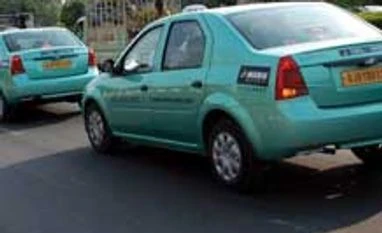 "Meru's fleet speeds up on revenue-share model")


 Connect with us on WhatsApp