In its annual ‘Technology, Media & Telecommunications Predictions’ (TMT) report, research entity Deloitte says while digital content consumption in India continues to grow in leaps and bounds, TV advertising is here to stay.
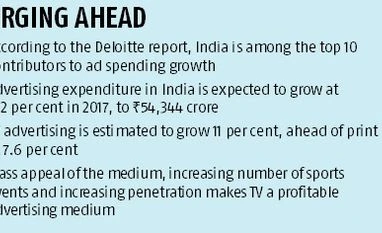
The report says India is among the top 10 contributors to ad spending growth, as are the US, Britain, China, Japan, Indonesia, the Philippines and Germany. Advertising expenditure in India is expected to grow at 11.2 per cent in 2017, to Rs 54,344 crore.
In 2017, ad spending is expected to increase across categories such as mobile wallets, telecom, banking, financial services and insurance, mobile handsets, fast moving consumer goods and consumer durables. The report estimates TV advertising to grow 11 per cent, ahead of print at 7.6 per cent, and other media (outdoor, radio and cinema) between seven and 12 per cent.
“Demonetisation hit the media industry hard. Companies had to limit their advertisement spends in the third (December) quarter, their peak advertising season. The effects might get carried to the next quarter. Having said this, ad expenditure will continue to grow, leaving behind this temporary setback,” the report adds.
On the relevance of TV as an advertising medium, the report points to four things — mass appeal of the medium, increasing number of sports events, increasing penetration of the medium and a better audience measurement system.
Apart from television, the other important segment in media & entertainment (M&E) the report focuses on the over-the-top (OTT) system. OTT is the term for audio, video, and other media content delivered over the internet without involvement of a multiple-system operator (MSO) in control or distribution of content.
Deloitte predicts OTT platforms would gain further popularity in India as it continues to help M&E companies launch, monetise and manage direct-to-consumer (DTC) content offerings.
Citing data from The Global Video Insights Report released by Vuclip, the TMT report says 55 per cent of viewers in India have moved to smartphones. “Mobile network usage is taking over broadband. The global video service and consumption report for the first quarter of 2016 states an average person checks his or her smartphone 85 times a day. Smartphones have evolved over the years and so has the way of interaction of users with their device. According to the Internet and Mobile Association in India, the internet user base will cross 500 million by 2018, with rural internet users being 210 million,” it adds in justifying the growth of OTT.
It cites the Akamai & Nasscom report that mobile video content would grow at an 83 per cent compounded annual rate in the next five years. A Frost & Sullivan report says there are 66 million unique connected video viewers in India, of which 1.3 million are paid subscribers. A lot of fluctuation is noted in the online video subscription numbers each month. The number of unique online video viewers will grow from 66 million in 2015 to 355 million in 2020. Digitisation of cash will be a reason.
“TV broadcasters, however, expect revenues from digital platforms to grow to 10-15 per cent in a few years, chiefly due to mobile advertising. OTT Video on Demand remains the win-win situation for both customers and service providers. Broadcasters have an inherent advantage because they produce a huge amount of content. Thus, they will be among the bigger players. But, there are many M&E companies (both local and international) who are keen to take the OTT route,” the report concludes.

 "TV ads to see double-digit growth in 2017, says Deloitte report")












 Connect with us on WhatsApp