Home / Markets / News / Asian stock markets ease, oil sinks as US weighs reserves release
Asian stock markets ease, oil sinks as US weighs reserves release
MSCI's broadest index of Asia-Pacific shares outside Japan fe.ll 0.2%, led by a 0.7% drop for Hong Kong's Hang Seng. Japan's Nikkei fell 0.2%. Australia's resource-heavy index was up 0.4%.
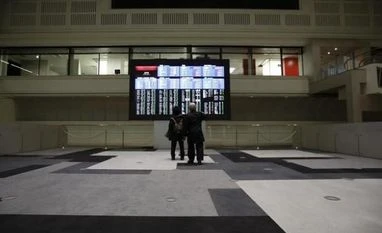
Visitors looks at an electronic board showing the Japan's Nikkei average at the Tokyo Stock Exchange (TSE) in Tokyo, Japan | File photo: Reuters
Asian stocks on Thursday eased after this week's global rally, following Wall Street's overnight stumble, while oil dropped sharply as the United States weighed a massive draw from its reserves to rein in surging fuel prices.
Brent crude futures were down 4.4% at $108.50 a barrel and U.S. crude futures fell more than 5% to $101.76 a barrel in morning trade.
The United States is considering releasing up to 180 million barrels of oil over several months from strategic reserves, four U.S. sources said, as the White House tries to lower fuel prices that have surged since Russia invaded Ukraine late last month.
A stocks rally, meanwhile, lost momentum as hopes for a quick peace started to fade and the upbeat sentiment turned to worry about looming interest rate hikes.
MSCI's broadest index of Asia-Pacific shares outside Japan fe.ll 0.2%, led by a 0.7% drop for Hong Kong's Hang Seng. Japan's Nikkei fell 0.2%. Australia's resource-heavy index was up 0.4%.
Overnight, the Dow Industrial Average, the S&P 500 and the Nasdaq Composite were down, following similar downward movements in European stocks.
"In U.S. markets, which we take our cue from, the sell-offs are reflecting an ongoing assessment of inflation threats and what the Fed is going to do about it," said Rob Carnell, chief economist at ING in Singapore.
"At the same time, in the last 24 hours, markets have responded cautiously positively to events in Ukraine, with Russia refocusing away from Kyiv, but things are still looking quite uncertain."
Bond markets were smouldering after a stinging sell off.
Two-year Treasury yields, which track policy expectations, were last at 2.2922% and have climbed more than 150 basis points for the quarter - the steepest such rise since 1984 on expectations of quick-fire interest rate hikes.
The yield on the 10-year Treasury note, which is more sensitive to the outlook for long-term growth, was last at 2.3378% after hitting 2.56% on Monday, the highest since May 2019.
Inflation continues to squeeze governments and central banks around the world. Germany registered a whopping 7.6% inflation rate on Wednesday, sending its 2-year bond yield into positive territory for the first time since 2014.
Spot gold was down slightly, 0.11%, at $1,930,74 an ounce. [GOL/]
(Editing by Himani Sarkar)
(Only the headline and picture of this report may have been reworked by the Business Standard staff; the rest of the content is auto-generated from a syndicated feed.)

 "Asian stock markets ease, oil sinks as US weighs reserves release")


 Connect with us on WhatsApp